
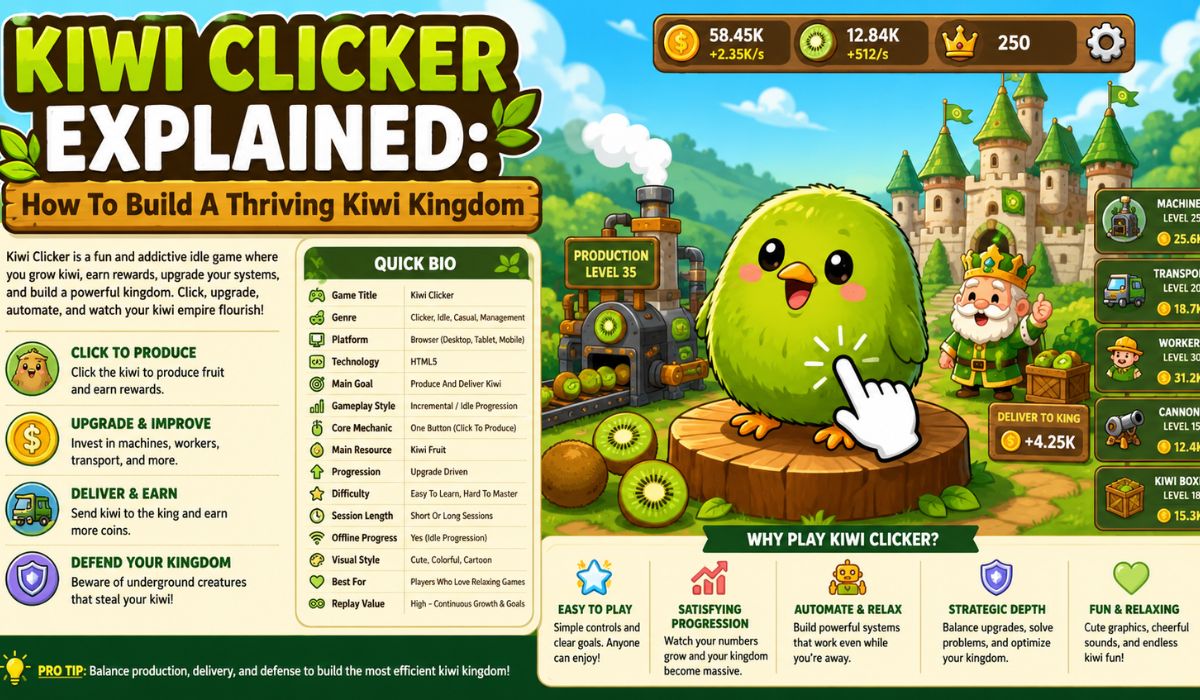
Some games become popular because they are difficult. Others succeed because they are competitive. But games like Kiwi Clicker prove that sometimes the most enjoyable experience comes from doing something simple and watching it grow into something surprisingly satisfying.
Kiwi Clicker is a browser-based idle and clicker game built around one idea: produce as many kiwi fruits as possible and turn a tiny operation into a thriving kingdom. At first, the gameplay feels almost effortless. You click, collect rewards, and purchase upgrades. But after a few minutes, the game reveals something deeper. Production lines become more efficient, transportation systems begin to matter, and every upgrade changes how quickly your kingdom grows.
That balance between simplicity and progression is exactly why clicker games continue to attract players in 2026. Kiwi Clicker takes familiar idle game mechanics and gives them personality through charming visuals, management elements, and constant growth.
This guide explores everything you need to understand about Kiwi Clicker. You will learn how the gameplay works, which upgrades matter most, how to avoid slow progress, and what strategies can help you create a successful kiwi empire from the beginning.
Before diving into advanced tactics, it helps to understand the game at a glance.
Quick Bio Information
| Category | Details |
|---|---|
| Game Title | Kiwi Clicker |
| Genre | Clicker, Idle, Casual, Management |
| Main Goal | Produce And Deliver Kiwi Efficiently |
| Gameplay Style | Incremental Progression |
| Platform | Browser |
| Technology | HTML5 |
| Device Support | Desktop, Tablet, Mobile |
| Control Method | One Button / Mouse Click |
| Main Resource | Kiwi Fruit |
| Progress System | Upgrade Driven |
| Difficulty | Easy To Learn |
| Session Length | Short Or Long Sessions |
| Core Mechanic | Click To Produce |
| Idle Elements | Automation And Scaling |
| Strategic Focus | Resource Efficiency |
| Visual Style | Cartoon And Colorful |
| Player Appeal | Relaxing And Rewarding |
| Replay Value | Continuous Progression |
What Is Kiwi Clicker?
Kiwi Clicker is an idle clicker game where players build an efficient fruit production system while expanding a growing kingdom. The gameplay starts with direct interaction. You repeatedly click to produce kiwi fruit, earn rewards, and reinvest those earnings into stronger systems.
The game combines several popular mechanics. It has the immediate feedback of clicker games, the long-term planning of management games, and the satisfying growth curve common in incremental games.
Unlike many idle games that focus only on waiting, Kiwi Clicker keeps players involved. Every decision influences progress. Upgrades affect production speed. Delivery improvements increase output. Better systems create stronger momentum.
The game’s visual identity also plays an important role. Instead of using complex menus or realistic graphics, Kiwi Clicker creates a relaxed environment with colorful visuals and playful animations. That lighter presentation makes long play sessions feel comfortable rather than overwhelming.
Another reason players enjoy Kiwi Clicker is accessibility. There are no complicated tutorials or advanced controls. New players can understand the basics within minutes while still discovering deeper optimization later.
This combination of simplicity and progression creates an experience that feels easy to enter but surprisingly difficult to stop playing.
How Kiwi Clicker Works: Understanding The Basic Gameplay Loop
Every successful idle game relies on a satisfying gameplay loop, and Kiwi Clicker follows a simple but effective cycle.
The player begins by producing kiwi fruit through clicking. Every successful action generates output and earns in-game currency. That currency becomes the foundation for expansion.
Instead of saving resources, progress depends on reinvestment.
Players use earnings to unlock improvements that increase productivity. Production becomes faster. Transportation becomes smoother. Workers become more efficient. Those upgrades produce additional income, which creates opportunities for even larger improvements.
Over time, the game gradually shifts from manual activity toward semi-automated growth.
This transformation is one of Kiwi Clicker’s strongest design choices.
At first, every kiwi feels earned through direct effort. Later, systems begin supporting themselves. Watching a once-small operation turn into an efficient production chain creates a strong sense of achievement.
Good progression in Kiwi Clicker depends on recognizing bottlenecks.
If production increases but transportation stays slow, resources pile up. If upgrades focus only on speed without improving output, growth slows down. The best approach is maintaining balance across all systems.
This constant cycle of production, upgrading, and optimization becomes the heart of the entire experience.
Starting Strong: Best First Steps For New Players
Many players unknowingly slow their progress during the opening phase because they upgrade randomly instead of building a foundation.
The first objective should always be creating stable production.
Early upgrades that directly increase kiwi output often provide the strongest return because they affect every future stage of growth. Producing more resources early creates stronger momentum later.
After production becomes reliable, attention should move toward movement and processing speed.
Transportation systems may appear less exciting than production upgrades, but they determine whether your output actually reaches its destination efficiently. A kingdom that creates fruit faster than it can deliver eventually becomes inefficient.
Another common mistake is spending all earnings immediately.
Saving briefly for meaningful upgrades often creates larger jumps in progress than repeatedly buying smaller improvements.
New players should also pay attention to rhythm rather than speed.
Constant clicking can help during the opening stages, but successful long-term play depends on balancing active play with automation. Building systems that continue generating value reduces unnecessary effort.
Players who focus on structure instead of rushing usually reach stronger results faster.
Starting smart often matters more than clicking quickly.
Understanding Every Upgrade In Kiwi Clicker
Upgrades are the engine behind growth in Kiwi Clicker.
Without upgrades, production stays small. With smart investments, a simple kiwi farm becomes a large and efficient kingdom.
Production upgrades are usually the first category players encounter. These improvements directly increase how much fruit is generated. Because production drives all future progress, these upgrades remain valuable throughout the game.
Machine improvements focus on scale.
Instead of increasing manual output, machines accelerate repeated tasks and reduce reliance on constant clicking. Efficient machine investment creates smoother long-term progression.
Transportation upgrades influence movement.
Fruit must travel efficiently through the kingdom. Faster transport creates a stronger production cycle because output reaches destinations sooner and generates income more quickly.
Worker improvements affect consistency.
As supporting systems improve, operations feel smoother and delays become less noticeable.
Storage-related upgrades also become increasingly important.
Greater capacity prevents wasted production and allows systems to operate longer without interruption.
One interesting aspect of Kiwi Clicker is how upgrades interact.
Increasing one category while ignoring others often creates bottlenecks. The strongest kingdoms develop balanced systems where production, delivery, and processing support one another.
Understanding those relationships turns random clicking into meaningful strategy.
How To Build A Faster And More Efficient Kiwi Production System
Building a thriving kiwi kingdom is not about upgrading everything equally. It is about understanding efficiency.
Efficiency begins with identifying which part of the system currently limits growth.
Sometimes production is too slow.
Sometimes transportation cannot keep up.
Sometimes upgrades become expensive before returns justify the investment.
The strongest players regularly evaluate where progress slows and improve that area first.
A useful mindset is thinking in cycles.
Every kiwi produced should move quickly, generate rewards, and immediately contribute toward stronger production.
If any stage slows down, the entire kingdom becomes less efficient.
Another effective habit is creating sustainable growth instead of chasing short-term bursts.
Small improvements that permanently increase output usually outperform temporary gains.
Automation also becomes increasingly valuable.
As production expands, manually managing every action becomes unrealistic. Strong automation allows players to step back while maintaining momentum.
Experienced players often discover that efficient kingdoms do not necessarily look busy.
They look balanced.
Production remains steady. Delivery stays smooth. Resources continue flowing without interruption.
That is ultimately the goal of Kiwi Clicker.
Not simply creating more kiwi.
But creating a kingdom where every part works together and growth never stops.
Defending Your Kiwi Kingdom Against Underground Threats
A thriving kingdom does not grow without resistance, and Kiwi Clicker introduces this idea through underground creatures that interfere with production. These disruptive elements add a layer of management that makes the game more interesting than simply clicking and upgrading.
At first, these interruptions may seem minor. Production slows, deliveries become less efficient, and resources disappear more quickly than expected. New players often assume they simply need more upgrades, but the real solution is understanding how to protect momentum.
The important lesson here is that production alone is not enough.
A strong kingdom combines output with stability.
When disruptions appear, players should avoid reacting emotionally by spending all available currency immediately. Instead, look at where the slowdown happens. If production remains high but delivery weakens, transportation upgrades may provide better results than increasing output again.
This creates an important strategic layer. Every improvement becomes a decision rather than an automatic purchase.
Players who anticipate problems generally maintain smoother growth than players who react only after progress stops.
There is also a psychological reason these interruptions work well in Kiwi Clicker. They break repetitive clicking and create small moments of problem-solving. Those moments make progress feel earned instead of automatic.
Eventually, experienced players begin treating obstacles as part of normal growth rather than unexpected setbacks.
That shift in thinking often marks the moment when players move from beginner to efficient kingdom builder.
The Best Kiwi Clicker Strategies To Progress Faster
Most players reach a point where upgrades become more expensive and progress feels slower. This stage is normal, but strategy determines whether growth continues or stalls.
One of the strongest approaches in Kiwi Clicker is prioritization.
Not every upgrade delivers equal value at every stage.
Early in the game, direct production increases often create the fastest gains because they multiply future earnings. During mid-game progression, transportation and support systems become more important because efficiency starts limiting growth.
Successful players continuously ask one question:
“What currently slows my kingdom the most?”
That single habit changes everything.
Another useful strategy is avoiding unnecessary over-clicking.
Clicking feels productive because it creates immediate results, but long-term progress comes from building systems that work efficiently even with less input.
Timing also matters.
Buying upgrades too early can reduce flexibility, while waiting too long slows growth. Learning to recognize those moments improves decision-making.
Players should also pay attention to scaling.
An upgrade that seems small now may become extremely valuable later because of how it interacts with existing production.
One overlooked strategy is patience.
Idle games reward consistent improvement more than aggressive action. Small gains accumulate over time and create surprisingly large differences later.
The strongest kingdoms are rarely built through speed alone.
They are built through smart decisions repeated consistently.
Why Kiwi Clicker Feels So Addictive And Rewarding
The popularity of clicker and idle games often surprises people who have never played them.
From the outside, the gameplay appears simple.
Inside the experience, however, there is a powerful cycle of progress and reward that keeps players engaged.
Kiwi Clicker does this particularly well.
Every action creates visible feedback. A click produces kiwi. Kiwi creates rewards. Rewards unlock improvements. Improvements increase production. Progress becomes visible almost immediately.
That constant sense of movement makes the game satisfying.
Unlike games that require long waits before success appears, Kiwi Clicker frequently rewards players with noticeable changes.
Visual design also strengthens engagement.
Small animations, bright colors, and playful movement create positive reinforcement that makes simple actions feel enjoyable.
The upgrade system adds another layer.
Each purchase changes the kingdom in visible ways, creating a sense of ownership over growth.
There is also an element of curiosity.
Players naturally wonder what happens after the next upgrade, the next production milestone, or the next improvement.
That curiosity encourages continued play.
Importantly, Kiwi Clicker remains approachable.
There are no complicated systems blocking progress. The challenge comes from optimization rather than memorization.
This balance between comfort and progression helps explain why idle games remain popular in 2026 and why Kiwi Clicker continues attracting players who want something relaxing but rewarding.
Common Beginner Mistakes And How To Avoid Them
Almost every Kiwi Clicker player makes mistakes early on, and most of them happen because progress feels easy at the beginning.
One common mistake is upgrading randomly.
Players see available options and buy whichever appears first without considering how systems interact. This often creates imbalance where one part of the kingdom grows faster than the rest.
Another mistake is focusing only on production.
Creating more kiwi feels exciting, but if delivery systems cannot keep pace, resources become inefficient.
Ignoring support upgrades creates hidden slowdowns.
Many players also underestimate automation.
Manual clicking works initially, but long-term growth becomes difficult without systems that continue producing value consistently.
Overspending creates another issue.
Buying every available upgrade immediately can leave players without flexibility when better opportunities appear.
There is also a tendency to chase short-term gains.
Small improvements feel rewarding, but sometimes saving for larger upgrades creates stronger long-term results.
Another overlooked mistake is ignoring patterns.
Players often continue doing what worked earlier even after the game changes.
Strategies should evolve as production expands.
Avoiding these mistakes does not require advanced knowledge.
It simply requires paying attention to how your kingdom behaves and adjusting decisions accordingly.
The more intentional your choices become, the faster progress feels.
Advanced Tips For Building A Thriving Kiwi Kingdom
Once the basics become comfortable, Kiwi Clicker becomes less about clicking and more about optimization.
Advanced players focus on creating systems that multiply value across the entire kingdom.
One powerful principle is compound improvement.
Instead of asking which upgrade looks strongest immediately, ask which improvement strengthens multiple areas over time.
A transportation upgrade that supports higher production later may create more value than a direct production increase today.
Advanced play also means recognizing diminishing returns.
Eventually, repeatedly investing in the same category becomes less effective than improving weaker systems.
Balance becomes more important than specialization.
Resource timing is another major skill.
Experienced players often delay purchases intentionally because waiting unlocks larger opportunities.
This creates stronger efficiency over long sessions.
Consistency matters as well.
Building reliable production usually performs better than chasing dramatic spikes.
Players should also pay attention to recovery.
If production slows unexpectedly, identifying the exact cause is usually faster than making random upgrades.
The most efficient kingdoms often appear calm.
Resources move steadily.
Systems support one another.
Progress continues without constant intervention.
That is where Kiwi Clicker becomes most satisfying.
You stop reacting to the game.
You begin designing the kingdom.
And once that happens, growth starts feeling effortless.
How Kiwi Clicker Compares To Other Popular Clicker Games
By the time players spend a few sessions in Kiwi Clicker, an interesting question usually appears: what makes this game feel different from other clicker games?
The answer is not complexity. It is balance.
Many clicker games focus almost entirely on numbers increasing. Others emphasize automation and eventually remove player involvement. Kiwi Clicker sits between those two approaches.
The game keeps the immediate satisfaction of clicking while gradually introducing management decisions.
That balance creates a stronger feeling of ownership.
Instead of simply watching values rise, players actively shape how their kingdom develops.
Compared with traditional idle experiences, Kiwi Clicker places more attention on movement, production flow, and upgrade interaction.
Compared with management-heavy games, it stays accessible and easy to understand.
Its visual style also helps separate it from more mechanical-looking incremental games. The colorful presentation keeps progression feeling light rather than overwhelming.
Another advantage is pacing.
Many clicker games either progress too quickly or become slow too early. Kiwi Clicker generally keeps rewards visible long enough to maintain motivation while still encouraging planning.
This makes it especially appealing for players who want a relaxed experience with enough strategy to stay interesting.
Players who enjoy optimization without complex rules often find that Kiwi Clicker offers an enjoyable middle ground.
The Hidden Systems That Make Kiwi Clicker More Interesting Than It Looks
At first glance, Kiwi Clicker appears straightforward.
Click. Produce. Upgrade. Repeat.
But underneath that simple structure, several systems quietly influence how enjoyable the game feels.
One of those systems is visible progression.
The game constantly communicates improvement. Production rises. Delivery becomes smoother. Kingdom activity increases.
Those visible changes make progress easier to appreciate.
Another hidden system is layered goals.
Players start by trying to earn more resources. Later, they begin optimizing routes, improving timing, and reducing inefficiencies.
Goals naturally evolve without requiring complicated instructions.
The game also creates short and long reward cycles.
Small rewards arrive frequently through upgrades and production increases. Larger rewards appear later as systems become more efficient.
That combination helps maintain engagement.
There is also a subtle management challenge.
Players are encouraged to think ahead rather than react immediately.
Should production increase?
Should transportation improve?
Should resources be saved?
These questions create decisions without making the game stressful.
That balance is difficult to design well and explains why Kiwi Clicker often feels more engaging than its simple controls suggest.
How To Create Your Own Long-Term Growth Strategy
Many players eventually discover that random upgrades stop producing strong results.
This is where strategy becomes important.
A long-term approach starts with defining priorities.
Ask what type of kingdom you want to build.
Do you prefer active sessions with frequent interaction?
Or do you prefer stronger automation and steady progress?
There is no single correct answer.
What matters is consistency.
Successful long-term growth usually follows a cycle.
Increase production.
Support delivery.
Strengthen supporting systems.
Repeat.
Avoid changing direction too often.
Frequent switching creates inefficiency.
Tracking progress mentally can also help.
Notice which improvements consistently feel valuable.
Notice where slowdowns appear.
Over time, patterns become easier to recognize.
Long-term players often stop thinking about individual upgrades and begin thinking about system health.
That shift transforms gameplay.
Instead of chasing numbers, players build reliable processes.
And reliable systems almost always outperform rushed decisions.
Why Kiwi Clicker Still Feels Relevant In 2026
Browser games have changed significantly in recent years.
Players now expect smoother performance, quicker access, and experiences that work across multiple devices.
Kiwi Clicker continues fitting those expectations surprisingly well.
Its browser-based design removes barriers.
Players can begin quickly without complex setup.
That convenience remains valuable.
The game also aligns with modern play habits.
Many players no longer want every session to require complete attention.
Idle progression gives flexibility while still creating meaningful rewards.
Another reason Kiwi Clicker remains relevant is accessibility.
The controls stay simple.
The rules remain understandable.
But progression still rewards smart decisions.
That combination allows new players to enjoy immediate progress while experienced players continue refining strategies.
The growing popularity of relaxing management and idle experiences also supports games like Kiwi Clicker.
Not every player wants competition.
Many simply want enjoyable progression that feels rewarding.
Kiwi Clicker delivers that experience effectively.
Its simplicity is not a limitation.
It is one of the reasons the game continues attracting players.
Is Kiwi Clicker Worth Playing?
After exploring production systems, upgrades, progression, and strategy, one final question remains.
Is Kiwi Clicker worth your time?
For most players interested in idle and clicker games, the answer is yes.
The game succeeds because it understands exactly what it wants to be.
It does not overwhelm players with unnecessary systems.
It does not require difficult controls.
Instead, it focuses on creating a satisfying loop of growth and improvement.
The strongest part of Kiwi Clicker is not clicking.
It is watching a small operation slowly transform into something larger.
That sense of development creates momentum that keeps players returning.
Players who enjoy optimization, relaxing progression, and management mechanics will likely find plenty to enjoy.
Players looking for deep storytelling or competitive challenge may prefer something different.
But for players who enjoy building efficient systems and seeing visible progress, Kiwi Clicker remains a strong choice.
Its simple idea becomes surprisingly rewarding once the kingdom begins growing.
Final Thoughts
Kiwi Clicker proves that simple ideas can become surprisingly engaging when they are built around satisfying progression.
What begins as a few clicks quickly develops into a larger system of production, upgrades, efficiency, and planning. Along the way, players learn that building a thriving kiwi kingdom is less about speed and more about making thoughtful decisions.
The game rewards balance, patience, and experimentation.
Whether you enjoy relaxing idle games, management mechanics, or simply watching numbers and systems grow, Kiwi Clicker offers a welcoming experience that stays enjoyable long after the first session.
Build carefully, upgrade wisely, and keep your kingdom moving.
The smallest kiwi operation can become something much bigger than expected.
FAQs About Kiwi Clicker
Is Kiwi Clicker Free To Play?
Kiwi Clicker is generally available as a browser-based experience that players can access without purchasing the game upfront. Availability may vary by platform hosting the game, but the core experience is designed to be easy to access.
Can Kiwi Clicker Be Played On Mobile?
Yes. Kiwi Clicker is designed using browser-friendly technology and can usually be played across desktop, tablet, and mobile devices. Performance may vary depending on device capabilities and browser settings.
What Is The Fastest Way To Progress In Kiwi Clicker?
Fast progress usually comes from balanced upgrading rather than constant clicking. Improving production while supporting transportation and efficiency creates stronger long-term results.
Is Kiwi Clicker More Active Or Idle?
Kiwi Clicker combines both styles. Early gameplay involves active interaction, while later stages introduce stronger automation and idle progression.
Do Upgrades Matter More Than Clicking?
Over time, upgrades become increasingly important. Manual clicking helps create momentum early, but efficient systems eventually drive most long-term progress.
Does Kiwi Clicker Have An Ending?
Kiwi Clicker focuses more on ongoing progression than reaching a final destination. Much of the enjoyment comes from improving efficiency and building a stronger kingdom.
Is Kiwi Clicker Good For Beginners?
Yes. The controls are simple, the goals are clear, and the progression system gradually introduces deeper decisions without becoming difficult to understand.
Why Do Players Keep Returning To Kiwi Clicker?
Players often return because the game creates continuous visible progress. Small improvements accumulate into meaningful growth, making each session feel rewarding.
Recommended For You: Temple Of Boom Explained: How To Survive, Fight Monsters, And Escape