
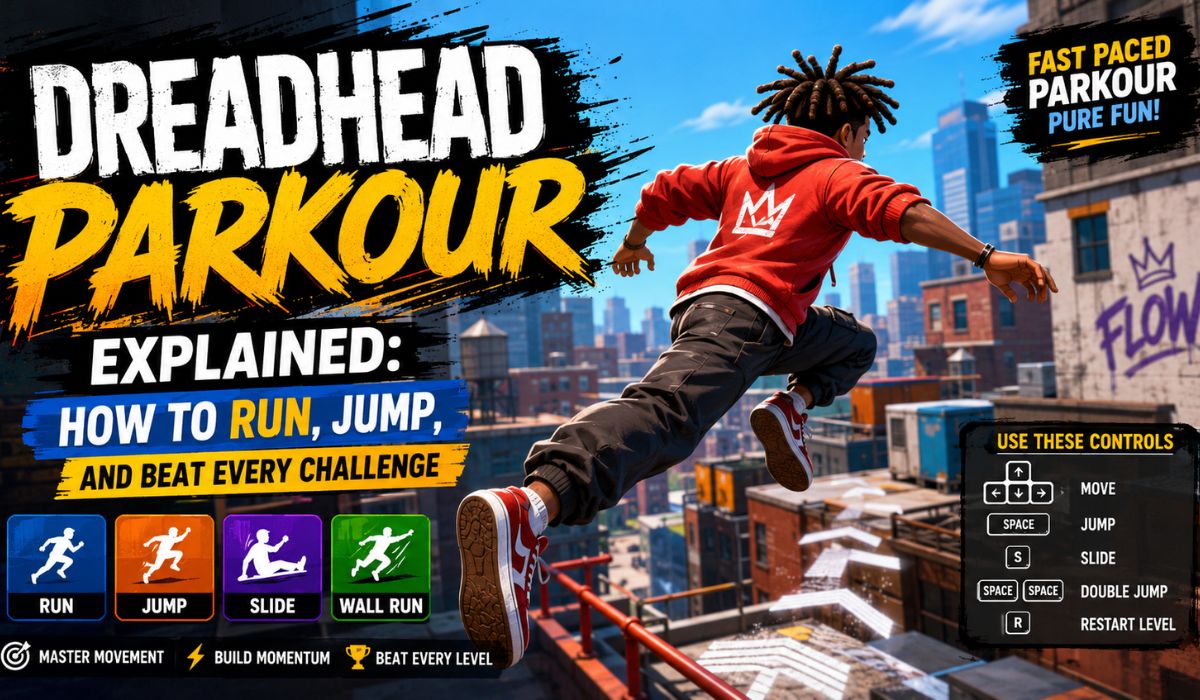
Some games focus on speed. Others focus on precision. Dreadhead Parkour combines both and turns simple movement into something exciting. From the moment a level begins, the game asks players to think quickly, react smoothly, and move with confidence. Every jump matters. Every wall can become part of your route. Every mistake teaches something useful.
Dreadhead Parkour is a browser-based platform and runner experience built around flowing movement and obstacle navigation. Instead of fighting enemies or collecting complicated upgrades, players improve by learning how to move better. That simple idea is what makes the game so enjoyable. You begin with basic running and jumping, but over time you start connecting actions together and moving through levels in ways that feel fast, smooth, and satisfying.
One of the strongest parts of Dreadhead Parkour is that it welcomes new players while still rewarding practice. Controls are easy to understand, yet mastering movement takes time. This creates a game loop that feels rewarding instead of frustrating. Whether you want a quick play session or want to improve your route times, there is always another challenge waiting.
This guide explains everything you need to know about Dreadhead Parkour, including gameplay, controls, movement skills, progression, and strategies that help you overcome difficult sections and enjoy the game more.
Quick Bio: Dreadhead Parkour At A Glance
| Category | Details |
|---|---|
| Game Name | Dreadhead Parkour |
| Genre | Parkour Platform Game |
| Play Style | Skill-Based Runner |
| Main Goal | Reach The Finish Line |
| Gameplay Focus | Movement And Momentum |
| Difficulty Style | Gradually Increasing |
| Platform | Web Browser |
| Cost | Free To Play |
| Main Skill | Timing |
| Secondary Skill | Spatial Awareness |
| Controls | Keyboard Or Touch |
| Movement Types | Run, Jump, Slide |
| Advanced Movement | Double Jump, Wall Run |
| Level Design | Obstacle-Based |
| Save System | Browser Progress |
| Player Experience | Quick Sessions |
| Challenge Style | Precision Movement |
| Replay Value | High |
| Best For | Casual And Skill Players |
| Learning Curve | Easy To Start, Hard To Master |
What Is Dreadhead Parkour?
Dreadhead Parkour is a movement-focused platform game where players travel across obstacle-filled environments using parkour techniques. The objective sounds simple: reach the end of the level. In practice, every stage asks players to combine timing, speed, and positioning to continue moving forward.
Unlike many traditional endless runners, Dreadhead Parkour is built around controlled movement instead of automatic speed. You decide when to jump, when to slide, and how to approach obstacles. This gives each level a more interactive feel because success comes from your decisions rather than random events.
The game creates excitement through momentum. A successful sequence feels smooth and natural. You jump over one obstacle, land cleanly, transition into a slide, then continue into another leap. These moments create the feeling of real flow that many players enjoy.
What also helps Dreadhead Parkour stand out is accessibility. You do not need long tutorials or complicated systems. You can start playing quickly and gradually improve through experience. This balance between simplicity and mastery makes the game appealing to both new and returning players.
How Dreadhead Parkour Works: Understanding The Gameplay Loop
At first glance, Dreadhead Parkour may appear straightforward, but the game follows a progression system built around repeated improvement. Every level introduces situations that encourage better movement decisions.
A typical session begins with studying the path ahead. Players quickly identify jumps, walls, narrow spaces, and possible routes. Once movement begins, maintaining rhythm becomes important. Stopping too often breaks momentum and makes obstacles harder to clear.
Levels encourage experimentation. If one route fails, players naturally adjust their timing or movement choices during the next attempt. This creates a learning cycle where each run feels productive.
As players improve, movement starts becoming automatic. You begin anticipating jumps before reaching them and react faster to changing terrain. This gradual improvement gives Dreadhead Parkour long-term replay value because success feels earned.
The game also rewards patience. Players who rush often miss jumps or lose control. Players who stay calm usually perform better and complete stages more consistently.
Dreadhead Parkour Controls Explained
Understanding the controls is the first major step toward improving performance. While the controls are simple, learning exactly when to use each action makes a big difference.
Movement is handled using the Arrow Keys or WASD controls. Running becomes the foundation of every level because movement speed affects how obstacles are approached.
Jumping is performed using the Spacebar. Good jumps depend more on timing than reaction speed. Jumping too early often reduces distance, while jumping too late can lead to collisions.
Sliding allows players to move under obstacles without stopping. Skilled players use slides not only for avoidance but also for preserving movement flow.
Double jumping introduces more flexibility. It allows players to recover positioning or reach platforms that require additional height. However, overusing it can interrupt rhythm and lead to poor landings.
Wall running adds another layer of movement. By jumping toward walls and continuing directional input, players can access alternate paths and maintain momentum through difficult areas.
The restart function helps players practice difficult sections quickly. Instead of viewing mistakes as failures, experienced players treat them as fast learning opportunities.
Once controls become familiar, attention naturally shifts from pressing buttons to planning movement.
Mastering Movement: How To Run, Jump, Slide, And Keep Momentum
Movement is where Dreadhead Parkour becomes truly interesting. The game rewards smooth actions rather than isolated inputs.
Momentum is one of the most important concepts to understand. Momentum means preserving speed and avoiding unnecessary interruptions. Players who maintain movement often clear obstacles more easily than players who constantly stop and restart.
Running creates the foundation for everything else. Good players rarely move randomly. They stay deliberate and prepare for upcoming obstacles before reaching them.
Jumping should feel connected to movement. Instead of thinking about jumping as a separate action, experienced players treat jumps as part of a continuous flow.
Sliding becomes useful because it allows forward motion while avoiding barriers. A well-timed slide feels almost invisible during gameplay because movement never stops.
Transitions matter as much as individual actions. Running into a jump, landing cleanly, then continuing immediately creates stronger performance than performing each movement independently.
One helpful habit is watching landing zones instead of watching your character. This improves reaction speed and makes routes easier to read.
Over time, players develop rhythm. That rhythm is often the difference between surviving obstacles and moving effortlessly through them.
Parkour Skills You Need To Beat Every Challenge
Winning in Dreadhead Parkour depends less on fast reactions and more on reliable movement habits. Strong players consistently apply a few important skills.
Timing is the most valuable ability. Good timing creates better jumps, smoother landings, and fewer mistakes. Players often improve dramatically simply by slowing down and choosing their moments carefully.
Spatial awareness is equally important. Understanding where platforms begin and end allows players to plan movement earlier.
Controlled speed becomes another useful skill. Faster is not always better. Some obstacles become easier when approached calmly instead of aggressively.
Wall usage can completely change level outcomes. Walls are not barriers—they are movement tools. Learning how to redirect movement through wall runs opens new possibilities and improves consistency.
Recovery skills also matter. Mistakes happen in every run. Experienced players learn how to adapt quickly instead of restarting immediately.
Finally, confidence plays a major role. Hesitation breaks momentum. Players who trust their movement and commit to decisions usually perform better and enjoy the experience more.
By combining timing, awareness, control, and momentum, Dreadhead Parkour becomes less about surviving obstacles and more about moving through them with style.
Common Obstacles And How To Get Past Them
As players progress in Dreadhead Parkour, the game introduces more complex obstacle patterns that test timing, control, and decision-making. These obstacles are not just barriers; they are designed to train better movement habits.
Narrow platforms are one of the most common challenges. They require precise landing control because even small timing errors can cause a fall. The best approach is to slow down slightly before jumping, ensuring your landing is centered and stable.
Long gaps appear frequently in mid-level stages. These gaps test momentum control. Players who maintain steady speed usually clear them more easily than those who hesitate. The key is to build speed before the jump rather than trying to adjust mid-air.
Fast obstacle sequences are another challenge type. These require quick decision-making, where players must react instantly to alternating jumps and slides. In these moments, rhythm becomes more important than raw speed.
Wall sections often introduce vertical movement challenges. Players must combine jumps with directional input to climb or redirect movement. These sections reward confidence and smooth transitions rather than repeated attempts.
Tight spaces that require sliding demand timing precision. Sliding too early can cause a crash, while sliding too late leads to collisions. The best strategy is to watch obstacle edges and react just before contact.
Understanding these patterns helps players anticipate what comes next instead of reacting too late.
Beginner Mistakes That Slow Players Down
Most new players struggle not because the game is difficult, but because they develop habits that interrupt flow. Recognizing these mistakes early makes improvement much faster.
One common mistake is rushing through levels without observing obstacles. Speed is important, but awareness is even more important. Players who take a moment to read the layout usually perform better.
Another issue is jumping too early. Early jumps reduce distance and often lead to missed platforms. Timing the jump closer to the edge gives better control and smoother landings.
Overusing the double jump is also a frequent problem. While it is useful for recovery, relying on it too often breaks momentum and reduces consistency.
Many beginners also ignore sliding opportunities. Sliding is not just a defensive move; it helps maintain speed and flow. Missing slides often results in unnecessary stops.
Restarting too quickly is another habit that slows improvement. Instead of learning from mistakes, players sometimes restart instantly without understanding what went wrong.
Finally, hesitation causes more failures than action. Waiting too long before committing to a jump often leads to worse outcomes than taking a controlled risk.
Avoiding these mistakes creates a noticeable improvement in performance even without advanced techniques.
Advanced Dreadhead Parkour Tips For Faster And Cleaner Runs
Once players become comfortable with basic movement, Dreadhead Parkour begins to reward optimization and flow control. At this stage, improvement comes from refinement rather than learning new controls.
One advanced technique is movement chaining. This means linking jumps, slides, and wall runs without breaking rhythm. Smooth chaining allows players to maintain momentum through entire sections of a level.
Route optimization is another important skill. Many levels have more than one possible path. Experienced players learn to identify faster or safer routes based on obstacle layout.
Efficient wall usage can significantly improve speed. Instead of treating walls as obstacles, skilled players use them to redirect movement or gain height without losing momentum.
Consistency becomes more valuable than speed at higher levels. A slightly slower but stable run often produces better results than a fast but unpredictable one.
Players also begin focusing on input efficiency. Every unnecessary movement can interrupt flow. Reducing extra jumps or corrections helps maintain cleaner runs.
Finally, advanced players develop rhythm awareness. This means feeling the timing of each movement sequence rather than consciously thinking about every action.
These improvements turn gameplay from reactive movement into controlled flow.
How Difficulty Increases As You Progress
Dreadhead Parkour uses a gradual difficulty system that helps players grow naturally. Early levels focus on basic movement, while later stages demand precision and mastery.
In the beginning, levels are designed to teach core mechanics such as jumping, sliding, and basic timing. Obstacles are spaced out to allow learning without pressure.
Mid-game levels introduce more complex combinations. Players begin to face sequences that require multiple actions in quick succession. This is where timing and momentum become critical.
As difficulty increases further, obstacle density becomes higher. Players must react faster and make decisions with less time to observe surroundings.
Later stages also introduce tighter platform spacing, which increases the importance of precision landing. Small mistakes become more costly, and recovery becomes harder.
At the highest level of difficulty, success depends on complete control of movement rhythm. Players who master flow can still perform well, but hesitation or inconsistent timing leads to failure.
This gradual progression ensures that players continuously improve without feeling overwhelmed too early.
Best Strategies For Completing Difficult Levels
Difficult levels in Dreadhead Parkour require a combination of patience, planning, and controlled execution. Instead of relying on fast reactions, successful players use structured approaches.
One effective strategy is breaking levels into smaller sections. Instead of trying to complete everything in one run, players focus on mastering one part at a time.
Another useful approach is studying the layout before moving forward. Even a brief moment of observation can help identify safer paths and reduce mistakes.
Practicing difficult sections repeatedly is also essential. Repetition builds muscle memory, which improves timing and reduces hesitation.
Managing failed attempts is equally important. Instead of rushing back into the level, players often benefit from analyzing what caused the mistake and adjusting their approach.
Consistency should always be prioritized over speed. Completing a level cleanly is more valuable than rushing through and failing repeatedly.
Finally, maintaining calm focus during challenging sections helps prevent unnecessary errors. Many failures occur not because of difficulty, but because of rushed decisions.
These strategies allow players to approach tough levels with confidence and control.
What Makes Dreadhead Parkour Different From Other Parkour Games
Dreadhead Parkour stands out because it focuses heavily on fluid movement rather than combat or complex systems. The gameplay is centered entirely on motion, rhythm, and precision.
Compared to other parkour-style games, it emphasizes simplicity. Players do not need to manage upgrades, enemies, or complicated mechanics. Instead, success depends purely on movement skill.
The physics-based feel also contributes to its identity. Movement feels responsive, which allows players to build momentum and maintain flow through levels.
Another difference is its accessibility. The game runs directly in a browser, making it easy for anyone to start playing without installation.
Unlike rhythm-based games, Dreadhead Parkour gives players freedom in timing. There is no fixed beat, only environmental timing, which makes each run feel unique.
This combination of accessibility, fluid movement, and skill-based design makes it appealing to both casual and dedicated players.
Can You Play Dreadhead Parkour On Mobile And Desktop?
Dreadhead Parkour is designed to work smoothly across multiple devices, making it accessible to a wide range of players.
On desktop systems, keyboard controls provide the most precise input. This makes it easier to perform fast and accurate movement combinations.
On mobile devices, touch controls are optimized for screen input. While slightly less precise than keyboard controls, they still allow full gameplay functionality.
The game adapts to screen size, which ensures that levels remain playable on both small and large devices.
Because it runs in a browser, there is no installation required. Players can start instantly, whether they are on a computer, tablet, or smartphone.
This flexibility is one of the reasons the game remains popular among casual players.
Is Dreadhead Parkour Worth Playing?
Dreadhead Parkour continues to attract players because it offers a simple idea executed very well. The game focuses on movement, timing, and flow rather than complicated systems. This makes it easy to start but rewarding to master.
For casual players, it is a great choice for short and enjoyable sessions. You can open the game, play a few levels, and immediately feel progress as your movement improves. There is no long learning process before having fun.
For more dedicated players, the game offers depth through repetition and mastery. Learning how to optimize movement, reduce mistakes, and complete levels smoothly creates a satisfying challenge that keeps improving over time.
Its biggest strength is consistency. Every level is built around the same core idea—move well, think quickly, and maintain control. This clarity makes the game accessible while still offering long-term engagement.
Overall, Dreadhead Parkour is worth playing if you enjoy fast-paced platform games that reward skill and practice.
What Makes Dreadhead Parkour Stand Out In 2026
In 2026, browser games continue to evolve, but Dreadhead Parkour remains relevant because of its timeless design. It does not rely on trends or complex systems. Instead, it focuses on pure gameplay.
One of its standout features is movement clarity. Every action feels intentional, and players always understand why they succeeded or failed. This transparency improves learning and makes progress feel fair.
Another strength is its replay value. Even after completing levels, players often return to improve their performance or try smoother runs.
The game also benefits from being lightweight and instantly accessible. No downloads, no setup, just immediate gameplay.
These qualities help it stay enjoyable even as newer games appear in the same genre.
Final Thoughts: Master The Flow And Enjoy The Challenge
Dreadhead Parkour is a simple game at its core, but it becomes deeply engaging once players start improving their movement skills. The combination of running, jumping, sliding, and wall running creates a gameplay experience centered around rhythm and control.
What makes the game enjoyable is not just completing levels, but learning how to move better each time you play. Every mistake teaches timing. Every successful run builds confidence. Over time, players naturally develop smoother movement and faster reactions.
Whether you are playing casually or aiming to master every level, the game rewards patience and practice. It is not about rushing through obstacles, but about finding your flow and maintaining it.
Dreadhead Parkour remains a strong example of how simple mechanics can create a highly enjoyable and skill-based experience. If you enjoy movement-focused platform games, it is definitely worth your time.
Frequently Asked Questions About Dreadhead Parkour
What Is Dreadhead Parkour About?
Dreadhead Parkour is a movement-based platform game where players run, jump, slide, and perform wall runs to complete obstacle-filled levels. The focus is on smooth movement and timing rather than combat or collecting items.
Is Dreadhead Parkour Free To Play?
Yes, the game is completely free to play in a web browser. There are no downloads or installations required, making it easy for anyone to start playing instantly.
How Do You Get Better At Dreadhead Parkour?
Improving in Dreadhead Parkour comes from practice and learning timing. Players should focus on maintaining momentum, studying level layouts, and avoiding unnecessary mistakes like early jumping or overusing double jumps.
Can You Play Dreadhead Parkour On Mobile Devices?
Yes, the game works on mobile devices through browser play. It uses touch controls that are optimized for smartphones and tablets, although desktop keyboard controls may feel more precise.
What Makes Dreadhead Parkour Different From Other Parkour Games?
Dreadhead Parkour focuses purely on movement and flow. Unlike many games in the genre, it avoids complex systems and instead emphasizes timing, rhythm, and clean navigation through obstacles.
Does Dreadhead Parkour Save Progress?
Yes, progress is usually saved in the browser. This allows players to continue from where they left off without restarting every time.
Is Dreadhead Parkour Suitable For Beginners?
Yes, it is very beginner-friendly. The controls are simple, and early levels are designed to teach movement gradually before introducing more difficult challenges.
Recommended For You: Kiwi Clicker Explained: How To Build A Thriving Kiwi Kingdom