
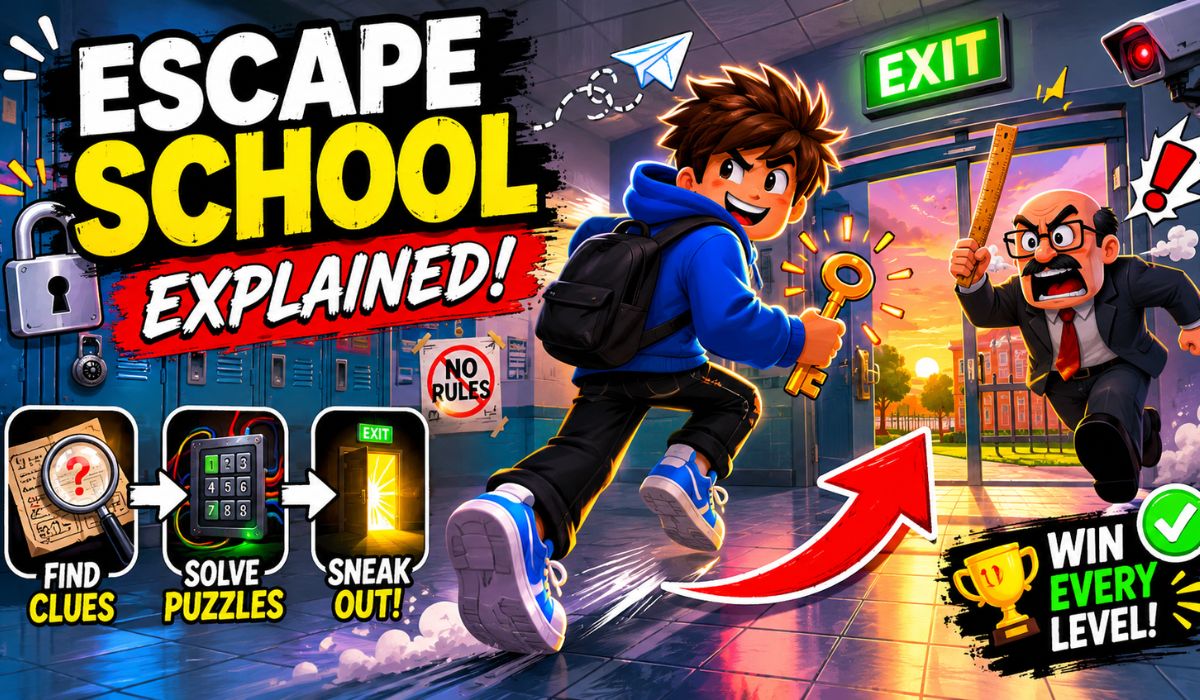
Escape School turns a simple idea into a surprisingly engaging adventure. Instead of racing through action scenes or collecting endless rewards, the game asks players to think, observe, and escape one room at a time. Every level places you inside a school environment filled with obstacles, hidden items, locked paths, and teachers that stand between you and freedom.
What makes Escape School interesting is how it combines movement, puzzle solving, and timing into one experience. Progress rarely comes from moving faster. It comes from paying attention, interacting with the environment, and noticing details other players might miss. Whether you are completely new to escape games or already enjoy puzzle adventures, learning how Escape School works can make every level more enjoyable.
This guide explores everything that matters, from controls and gameplay to puzzle strategies and progression, so you can understand the game more deeply and improve naturally.
Quick Bio Information
| Detail | Information |
|---|---|
| Game Name | Escape School |
| Genre | Escape Game |
| Style | Action Puzzle Adventure |
| Main Goal | Escape The School |
| Core Gameplay | Exploration And Puzzle Solving |
| Movement | Keyboard Or Touch Controls |
| Interaction Key | E |
| Jump Key | Spacebar |
| Mobile Support | Yes |
| Desktop Support | Yes |
| Tablet Support | Yes |
| Developer | emolingo games |
| Release Period | May 2024 |
| Latest Update | February 2026 |
| Rating | 4.2 |
| Votes | 503,805 |
| Live Activity | 1,000+ Players |
| Main Challenge | Avoid Getting Caught |
What Is Escape School?
Escape School is built around one clear objective: find a way out. Instead of giving players direct instructions, the game encourages discovery. You enter rooms, observe surroundings, interact with objects, and gradually unlock a path forward.
At first glance the experience may appear simple, but the design creates tension through limited information and environmental puzzles. Every room becomes a small challenge where progress depends on noticing clues and understanding how different objects connect.
Unlike games that focus purely on speed, Escape School rewards patience and curiosity. Players who slow down often perform better than players who rush.
How Escape School Gameplay Works
The gameplay follows a repeating but satisfying loop. You begin in a controlled environment and quickly realize that the exit is not immediately available. Hidden clues, interactive objects, and environmental obstacles become the tools that move progress forward.
A typical level begins with exploration. You move around the room and test objects. Some items may trigger events, while others reveal hidden paths. Once the puzzle becomes clear, the player acts quickly before being interrupted.
As levels advance, challenges become more layered. Rooms become larger, interactions become more complex, and timing becomes increasingly important.
Controls And Movement Guide
Movement is simple to learn but important to master. Players use W, A, S, and D or arrow keys to move around. Spacebar controls jumping, while the E key activates interactions.
Movement matters more than many players expect. Small positioning changes can determine whether an interaction succeeds or whether a player reaches cover in time.
Experienced players usually move with purpose. They scan a room first and then act rather than jumping into random actions.
Good movement habits create smoother progression later in the game.
How To Sneak Out Without Getting Caught
Stealth is one of the most important ideas inside Escape School. Teachers and obstacles create pressure that forces players to think before moving.
Successful escapes usually follow a simple pattern. Observe first, move second.
Watch for safe openings and avoid crossing large spaces without understanding what lies ahead. If an area feels risky, explore side routes and interact with nearby objects before committing.
Many failed attempts happen because players panic. Calm movement often works better than quick movement.
Solving Puzzles Faster
Puzzles in Escape School rely more on observation than difficulty. The solution is usually inside the room already.
Players who perform well develop a habit of checking everything. Doors, desks, switches, corners, and unusual objects may all matter.
When stuck, return to what seems ordinary. Puzzle games frequently hide progress behind overlooked details rather than complicated logic.
Another helpful approach is connecting actions. If one object changes the room, ask what new opportunity that created.
Hidden Items And Secret Discoveries
Exploration adds another layer to Escape School. Not every useful object sits directly in front of the player.
Hidden items may unlock alternate routes, reveal shortcuts, or simply reduce the time required to solve a room.
Many players replay levels because they discover something they missed during earlier attempts.
Secret areas also improve replay value. Returning with more experience often reveals paths that seemed impossible before.
How Levels Become More Challenging
Early levels act as training. They teach movement, interaction, and puzzle logic.
As progression continues, levels become more demanding. Rooms grow larger and require players to combine multiple ideas instead of solving one challenge at a time.
Later sections usually require better timing and stronger awareness.
This progression design helps players improve naturally rather than overwhelming them immediately.
Strategies To Win Every Level
Winning consistently depends on habits rather than luck.
Players who clear levels efficiently tend to follow a pattern. They enter slowly, observe everything, identify possible exits, and interact only when necessary.
A useful strategy is reducing unnecessary movement. Walking less often means noticing more.
Another powerful habit is remembering previous layouts because puzzle design sometimes rewards familiar thinking.
Small improvements eventually create faster escapes.
Common Mistakes Players Make
Many players struggle for reasons that have nothing to do with difficulty.
One common mistake is assuming every puzzle has a complicated answer. Often the solution is simpler than expected.
Another mistake is ignoring interaction opportunities. Pressing the interaction key at the right moment can completely change progress.
Some players also move too quickly and miss visual clues.
Recognizing these habits can improve performance immediately.
Beginner Tips That Make A Big Difference
New players improve fastest when they focus on understanding instead of winning.
Spend time learning how rooms communicate information. Notice colors, object placement, and environmental hints.
Experiment without fear of failure. Escape games reward testing ideas.
Replaying earlier sections can also build confidence and reveal patterns that become useful later.
Improvement usually happens naturally once observation becomes a habit.
What Makes Escape School Different
Many escape games focus entirely on puzzle solving. Escape School blends puzzles with movement and stealth, creating more variety.
The school setting also makes rooms feel connected and believable.
Because each level encourages exploration, players experience more discovery than linear progression.
This combination creates a rhythm that feels relaxed and challenging at the same time.
Replay Value And Long-Term Appeal
One reason players return to Escape School is that knowledge changes the experience.
Rooms that once felt impossible become easier after understanding patterns and interactions.
Players often challenge themselves by escaping faster or discovering alternate solutions.
This creates long-term value beyond simply finishing the game once.
Is Escape School Worth Playing?
For players who enjoy puzzle games, exploration, and light action, Escape School offers an enjoyable experience.
The controls remain easy to learn while the room design creates enough challenge to keep players interested.
The game works especially well for players who prefer thinking and experimentation instead of constant fast action.
Its broad device support and accessible gameplay also make it easy to pick up and play.
Why Escape School Continues To Stay Popular In 2026
Escape-style gameplay remains popular because it creates immediate goals and satisfying progress.
Escape School fits this trend by combining approachable controls with steady challenge growth.
Players enjoy the feeling of solving problems independently and discovering solutions through exploration.
With updates continuing and player activity remaining strong, the game continues attracting both new and returning players.
Final Thoughts
Escape School proves that simple ideas can create memorable gameplay. Escaping classrooms, solving environmental puzzles, and learning through experimentation turns every level into a small adventure.
The best way to enjoy the game is not to rush. Explore carefully, interact with everything, and trust observation more than speed.
Each room teaches something useful, and every failed attempt becomes part of the solution. Once you understand that rhythm, Escape School becomes much more rewarding.
FAQs About Escape School
Is Escape School Easy For Beginners?
Escape School is beginner friendly because the controls are simple and the early levels introduce mechanics gradually. New players can improve quickly by focusing on exploration and observation.
How Do You Escape Faster?
Move carefully instead of quickly. Learn room layouts, interact with objects thoughtfully, and avoid repeating failed paths.
Are There Hidden Secrets In Escape School?
Yes. Exploration often reveals hidden items, alternate routes, and discoveries that make progression easier.
Does Escape School Become Harder Later?
Yes. Later rooms usually require better timing, more observation, and multiple puzzle steps.
Can You Play Escape School On Mobile?
Yes. The game supports phones and tablets in addition to desktop play.
What Is The Most Important Skill In Escape School?
Observation is usually the most valuable skill because clues are often placed directly in the environment.
Do You Need Fast Reflexes To Win?
Not necessarily. Smart decisions and puzzle awareness are generally more important than speed.
Why Do Players Replay Escape School?
Players often replay levels to improve completion times, find secrets, and experiment with different solutions.
Recommended For You: Vortelli’s Pizza Explained: How To Run Your Restaurant And Keep Customers Happy