
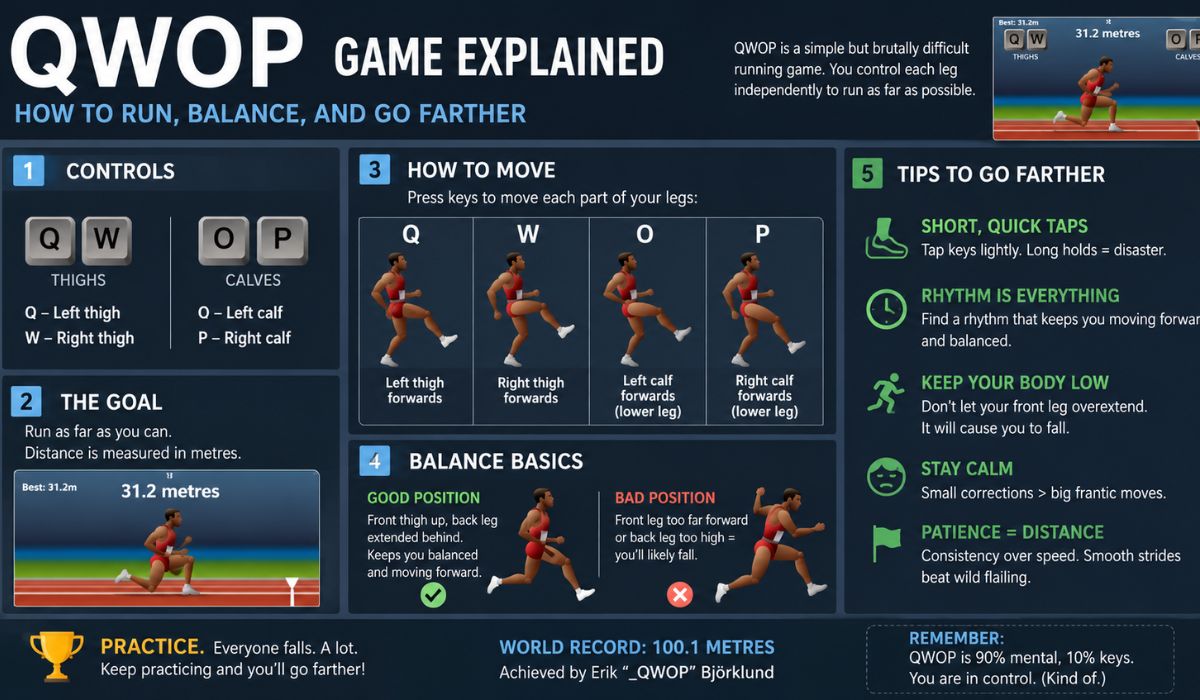
Some games are built around speed. Others reward strategy or quick reactions. The QWOP Game became famous for doing something completely different: making simple movement feel incredibly difficult.
At first glance, the game looks easy. You control a runner on a flat track and try to move forward. There are no enemies, no complicated levels, and no special powers. Yet after only a few seconds, most players discover that moving even a short distance can feel impossible.
That challenge is exactly why the QWOP Game became one of the internet’s most memorable skill games.
Instead of controlling a character with one movement key, players must coordinate separate parts of the runner’s legs. Every step requires balance, rhythm, timing, and patience. Small mistakes often lead to dramatic falls, while tiny improvements feel surprisingly rewarding.
Years after becoming popular online, the QWOP Game continues attracting players because of its unusual mix of humor, frustration, and skill development. It is simple enough for anyone to start but difficult enough to keep players returning.
This guide explains how the game works, how the controls create movement, why balance matters so much, and how players can run farther with smarter techniques.
Quick Bio Information
| Detail | Information |
|---|---|
| Game Name | QWOP Game |
| Developer | Bennett Foddy |
| Genre | Physics Skill Game |
| Gameplay Style | Running Simulation |
| Main Objective | Move Forward Without Falling |
| Control Keys | Q, W, O, P |
| Core Skill | Balance And Coordination |
| Platform | Browser |
| Device Support | Desktop |
| Gameplay Type | Single Player |
| Difficulty Level | High |
| Learning Curve | Steep But Rewarding |
| Famous For | Difficult Controls |
| Main Challenge | Leg Coordination |
| Release Era | Early Browser Game Era |
| Visual Style | Minimal And Functional |
| Average Session | Short Attempts |
| Best For | Players Who Enjoy Challenges |
| Replay Value | Very High |
| Community Reputation | Frustrating And Fun |
What Is The QWOP Game?
The QWOP Game is a browser-based physics running experience where players attempt to move an athlete forward using only four keyboard keys. Unlike traditional sports games that simplify movement into one direction button, QWOP separates leg control into multiple parts.
The unusual control system changes everything.
Players do not directly tell the athlete to run. Instead, they influence how each leg moves and allow momentum to create forward motion. Success comes from understanding body movement rather than pressing keys quickly.
This creates a gameplay loop that feels completely different from normal running games. Every step becomes meaningful. Every adjustment changes balance. Every small gain feels earned.
One reason the game remains popular is that it creates natural tension. Even after learning the basics, players continue improving through experimentation. Distances that once seemed impossible eventually become realistic goals.
Although the game appears humorous from the outside, it quietly teaches an important lesson about movement mechanics. Small changes in timing can create huge differences in results.
That mix of simplicity and challenge turned the QWOP Game into a lasting internet classic.
The Story Behind QWOP And Why It Became So Popular
The QWOP Game was created by Bennett Foddy, a developer known for making games that challenge expectations about movement and control.
The original idea was unusual. Rather than making movement easy, the design intentionally made running awkward and difficult. Players were forced to think about something most people never notice in everyday life: how complex walking and running actually are.
When videos of players falling repeatedly began spreading online, interest grew quickly. People laughed at dramatic failures, but they also became curious to try for themselves.
Soon, the QWOP Game became known as one of the most recognizable browser challenges on the internet.
Its popularity lasted because the difficulty never felt unfair. Players could see progress. Running five meters became ten. Ten became twenty. Improvement happened slowly, creating satisfaction with each new attempt.
Another reason for the game’s success is that it appeals to many types of players. Casual players enjoy the funny moments. Competitive players chase better distances. Content creators enjoy sharing reactions.
Even today, many modern physics-based games follow ideas that helped make QWOP memorable: unusual controls, meaningful mistakes, and rewarding mastery.
Understanding The QWOP Controls: What Q, W, O, And P Actually Do
The control system is the heart of the QWOP Game.
At first, the four keys appear random. In reality, each key controls a specific part of the athlete’s movement.
The Q and W keys influence the thighs.
The O and P keys influence the calves.
Instead of acting independently, these movements interact with each other continuously. Pressing one key changes weight distribution. Pressing another changes leg extension. Combining them creates forward movement.
New players often make the same mistake: they try to press keys rapidly.
Speed rarely helps.
The better approach is understanding how movement sequences affect balance.
Think of the runner as a moving structure. One leg creates support while the other creates momentum. If both actions happen at the wrong time, the athlete loses stability.
Good movement usually starts slowly.
Players learn to observe posture, adjust timing, and gradually build rhythm.
After enough practice, the controls stop feeling random and begin feeling predictable.
That moment is where the game becomes surprisingly satisfying.
Your First Run: How To Start Moving Without Falling
The first few attempts in the QWOP Game often look chaotic.
The runner falls backward.
The runner collapses forward.
Sometimes the athlete barely moves at all.
This happens because players naturally expect instant response. QWOP rewards patience instead.
A good first run starts with controlled movement.
Rather than trying to sprint immediately, focus on generating a stable first step. Small movements create opportunities to recover balance.
Watch the body angle.
If the athlete leans too far forward, movement becomes unstable. If the body stays too upright, momentum disappears.
Learning recovery is just as important as learning movement.
Many successful runs include moments where players temporarily lose balance and then regain control.
Another useful lesson is accepting short distances.
In many games, progress means completing levels. In QWOP, progress often means improving from two meters to five.
That shift in expectations helps players enjoy the process.
Eventually, actions that once required concentration begin happening naturally.
What looked impossible becomes manageable.
And that is where the real fun begins.
How Balance Works In QWOP And Why Most Players Fall
Balance is the hidden system that controls nearly everything in the QWOP Game.
The athlete does not simply move left or right. Every movement changes the center of weight and affects momentum.
That means balance is always changing.
When one leg extends too far, body position shifts. When recovery comes too late, the athlete collapses.
Players who understand balance stop reacting and start predicting.
Good movement usually follows a repeating cycle.
Generate motion.
Transfer weight.
Stabilize.
Repeat.
Trying to move faster than this cycle usually causes failure.
Another overlooked factor is overcorrection.
After losing balance, many players immediately press more keys. This often creates larger problems.
Experienced players instead make smaller adjustments and allow momentum to settle.
This approach creates smoother movement and better control over longer distances.
Over time, players discover that QWOP is not really about running.
It is about managing movement efficiently.
Once that idea becomes clear, running farther starts feeling less impossible and more like a skill that can actually be learned.
Best QWOP Strategies To Run Farther
Once players understand movement and balance, the next challenge in the QWOP Game is building consistency. Most players eventually discover that distance is not created by speed alone. The players who go farther usually move with more control rather than more force.
One of the most useful ideas in QWOP is rhythm.
The game rewards repeatable movement patterns. When players begin developing a stable sequence of key presses, the runner becomes easier to control. Instead of reacting to every stumble, players begin anticipating body movement.
Momentum matters more than acceleration.
Trying to create huge steps often causes dramatic falls because the runner cannot recover quickly enough. Smaller, controlled movements usually create smoother forward progress over time.
Body position also plays an important role. When the athlete remains slightly forward without collapsing, movement becomes more efficient. Many experienced players focus on preserving balance first and gaining speed second.
Another effective strategy is reducing unnecessary correction.
Players often lose distance because they constantly change movement patterns. Staying calm and repeating successful actions usually creates better results.
A helpful way to improve is to set small goals.
Instead of aiming for long distances immediately, focus on reaching slightly farther than the previous attempt. That gradual progress builds familiarity with movement and reduces frustration.
Long runs in QWOP rarely happen by accident. They are usually built from steady rhythm, careful balance, and patience.
Common QWOP Mistakes And How To Avoid Them
The QWOP Game has a reputation for being difficult, but many failures happen for predictable reasons.
One of the biggest mistakes is pressing keys too quickly.
Because the controls feel unusual, beginners often believe more input means more control. In reality, excessive input creates unstable movement and causes the runner to lose balance.
Another common mistake is ignoring posture.
Players tend to focus only on leg movement while forgetting that body position determines whether the athlete stays upright. Looking at the runner’s overall shape helps predict problems before they happen.
Many players also restart too quickly.
A stumble does not always mean failure. Sometimes awkward positions can still be recovered with careful movement. Learning recovery creates noticeable improvement.
Overcorrection is another major problem.
When balance begins shifting, players often respond aggressively. That reaction usually pushes the runner farther out of control. Smaller adjustments often work better.
There is also a psychological mistake that slows progress.
Players expect improvement too quickly.
Because QWOP appears simple, people often become frustrated after short sessions. The reality is that learning movement takes time.
Treating every attempt as practice rather than success or failure creates a better experience.
Players who stay patient often improve faster than players who chase immediate results.
Advanced QWOP Techniques For Experienced Players
After mastering the basics, the QWOP Game starts revealing deeper layers of control.
Experienced players begin thinking less about individual keys and more about movement patterns.
At this stage, efficiency becomes more important than survival.
Advanced movement focuses on creating controlled cycles that maintain forward momentum with minimal correction. Instead of producing large motions, experienced players often create smaller but cleaner steps.
Timing becomes increasingly important.
Experienced runners learn to identify the exact moment to shift weight and transfer momentum into the next movement cycle. Even tiny changes can influence performance.
Recovery skill also becomes more valuable.
Advanced players accept that imperfect movement happens. Rather than stopping after mistakes, they learn how to restore posture and continue.
Another technique involves maintaining relaxed input.
Pressing keys with deliberate timing usually works better than frantic reactions. Movement becomes smoother and energy remains directed forward.
Long-distance runs often depend on recognizing subtle warning signs.
Small body tilts, uneven recovery, and unstable foot placement can signal future problems.
Experienced players begin correcting these signs before obvious mistakes appear.
This deeper understanding transforms QWOP from a funny challenge into a genuine skill game.
Why QWOP Feels So Difficult But So Rewarding
The QWOP Game remains memorable because of the emotions it creates.
Most games make players feel powerful quickly.
QWOP does the opposite.
It introduces failure immediately and asks players to improve gradually.
At first, this seems frustrating.
But that difficulty is also why progress feels meaningful.
Every small improvement creates visible results. Moving farther than before becomes exciting because players know they earned it.
The game also changes expectations.
Instead of chasing victories, players begin appreciating learning.
That shift creates a surprisingly satisfying experience.
Psychologists often describe this type of engagement as challenge-based motivation. When tasks feel difficult but achievable, people remain interested longer.
QWOP naturally creates this feeling.
The game continuously shows players what is possible while making improvement feel personal.
Another reason it feels rewarding is that the feedback is immediate.
Every movement creates visible consequences.
Players instantly see whether a decision helped or hurt.
That direct connection between action and result creates strong engagement.
Even failure becomes entertaining.
A dramatic fall often feels funny instead of discouraging.
That combination of humor and challenge helps explain why players continue returning years later.
Can You Play QWOP On Different Devices?
As gaming habits continue changing in 2026, many players wonder whether the QWOP Game works across multiple devices.
The game was originally designed around keyboard input and remains strongest in a desktop environment.
That design choice makes sense because the control system depends on four separate keys working together.
Desktop play generally offers the most precise experience.
Players can develop rhythm more naturally and maintain better timing.
Smaller keyboards or alternative input methods may change the feel of movement.
Modern browser technology has also helped preserve access to games that originally depended on older web formats. This allows many classic browser experiences to remain playable through updated implementations.
However, QWOP still feels intentionally unusual.
Even with modern devices, the challenge remains part of the design rather than a technical limitation.
For new players, starting on a comfortable desktop setup usually creates the best learning experience.
Choosing a stable keyboard position, minimizing distractions, and allowing time for practice can improve results more than changing devices.
The interesting thing is that QWOP has never depended on graphics or hardware power.
Its appeal comes from mechanics.
That simplicity is one reason people continue discovering the game even years after its release.
And once players finally achieve a smooth run, the experience still feels surprisingly satisfying.
Games Like QWOP You Should Try Next
After spending time with the QWOP Game, many players begin looking for experiences that create a similar feeling. That feeling is not simply difficulty. It is the combination of unusual controls, physical movement, trial and error, and the satisfaction that comes from improvement.
Games inspired by physics often attract QWOP players because they reward experimentation instead of memorization.
What makes these experiences enjoyable is that they challenge everyday expectations. Walking, climbing, balancing, or moving objects suddenly become meaningful skills instead of automatic actions.
Some games focus on awkward movement mechanics that create humorous situations. Others increase difficulty through precision and timing. A few create emotional highs by making small achievements feel significant.
Players who enjoy QWOP usually appreciate games that encourage persistence. They often prefer games that allow mistakes, reward practice, and turn failure into entertainment.
Another reason people search for similar games is replay value.
Because movement-based challenges rarely unfold the same way twice, every attempt feels different. Success comes from adaptation rather than repeating fixed solutions.
The appeal of QWOP also helped influence a broader interest in challenge-focused design. Modern players increasingly enjoy experiences that value improvement and experimentation over immediate rewards.
If QWOP taught anything, it showed that simple ideas can become unforgettable when execution feels unique.
Why The QWOP Game Still Matters In 2026
Many browser games disappear after short periods of popularity, but the QWOP Game continues to remain recognizable years later.
Part of that lasting appeal comes from its design philosophy.
The game never relied on realistic graphics, large worlds, or constant updates. Instead, it focused on a single idea and executed it in a memorable way.
That approach still feels relevant in 2026.
Modern gaming includes advanced technology and increasingly complex systems, yet players continue returning to experiences that offer strong mechanics and immediate feedback.
QWOP also influenced conversations about difficulty in games.
It showed that challenge does not need to feel unfair. Players often accept repeated failure when progress feels possible and success feels earned.
The game introduced many players to the idea that controls themselves can become gameplay.
Instead of controlling outcomes directly, players learn systems and adapt to them.
Today, that design philosophy appears in many modern indie games and physics-driven experiences.
QWOP remains a reminder that creativity often matters more than complexity.
Even now, new players continue discovering the game and experiencing the same cycle of confusion, laughter, frustration, and improvement.
That kind of staying power is rare.
And it explains why QWOP continues earning attention long after its original rise to popularity.
Final Thoughts
The QWOP Game became famous because it transformeqwop gamed a simple action into a memorable challenge.
Running in the game is not really about speed. It is about understanding movement, managing balance, staying patient, and gradually improving.
That design makes every small success feel earned.
What begins as confusion eventually becomes rhythm. What starts as repeated falling turns into controlled movement.
Even years later, the experience remains fresh because it asks players to learn rather than simply react.
Whether you play for a few minutes or spend time chasing longer distances, the QWOP Game offers something many games struggle to create: genuine satisfaction through improvement.
And once you finally put together a smooth run and move farther than ever before, you understand why so many players still remember it.
FAQs About QWOP Game
Is QWOP Game Free To Play?
The QWOP Game became widely known because players could quickly access and try it without needing complicated setup. Availability may vary depending on platform and version, but the experience remains centered around simple access and immediate gameplay. Its lightweight design helped make it popular among browser game fans.
Why Is QWOP Game So Hard?
The difficulty comes from controlling multiple parts of movement separately. Instead of pressing one button to run, players must coordinate several actions while maintaining balance. The game turns a movement people normally perform automatically into something that requires attention and practice.
What Is The Best Strategy In QWOP Game?
The most effective approach is usually slow and controlled movement. Players who focus on rhythm, body position, and steady progress often perform better than players who rush. Consistency generally matters more than speed.
Can Beginners Enjoy QWOP Game?
Yes. In fact, beginners often enjoy the game because the early attempts create unexpected and funny moments. The challenge becomes more rewarding when players stop expecting perfection and start treating each attempt as progress.
How Long Does It Take To Improve At QWOP?
Improvement varies from player to player. Some people begin understanding movement within a short session, while others need more practice. Because the controls are unusual, progress often appears gradually rather than suddenly.
Does QWOP Require Fast Reflexes?
Not as much as people expect. Timing helps, but success depends more on control and rhythm than reaction speed. Players who stay calm often perform better than players who move quickly.
Is QWOP Mostly Skill Or Luck?
Skill plays the larger role over time. Early attempts may feel random, but experienced players consistently achieve better results because they understand movement patterns and balance.
Why Do Players Keep Returning To QWOP?
Players return because the game creates meaningful progress. Small improvements feel rewarding, and each run feels slightly different. The combination of challenge, humor, and visible growth gives the game strong replay value.
Recommended For You: Escape School Explained: How To Sneak Out, Solve Puzzles, And Win Every Level