
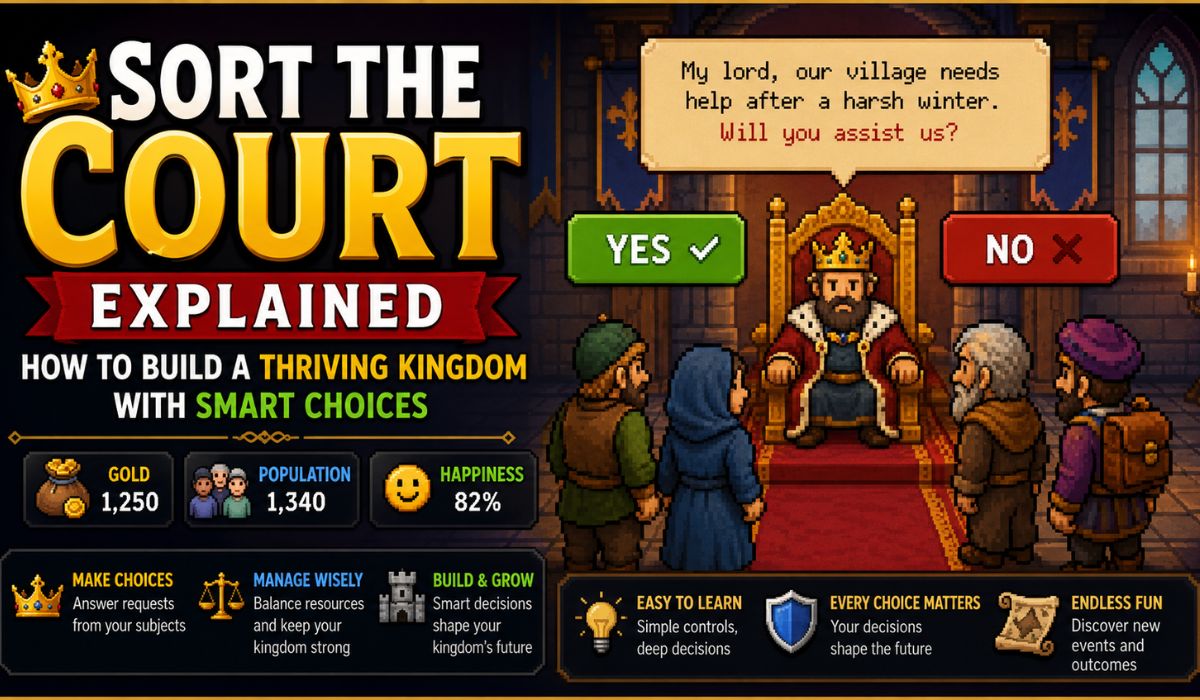
At first glance, Sort The Court looks like a simple game built around one easy idea: answer questions with either Yes or No. But after only a few minutes of play, it becomes clear that the game offers more than quick decisions. Behind every answer is a chain of consequences that slowly shapes the future of your kingdom.
In Sort The Court, you become the ruler of a growing kingdom. Citizens, merchants, travelers, and unusual visitors enter your throne room every day with requests, opportunities, and strange situations. Some want support. Others want money. A few bring surprises that completely change the direction of your kingdom.
What makes Sort The Court interesting is that there are no complicated menus or difficult controls. Instead, the challenge comes from understanding people, managing resources, and making choices that create long-term success.
Released as a browser-based management experience and still widely enjoyed in 2026, Sort The Court continues to attract players because it combines strategy, humor, and experimentation in a format that anyone can understand.
This guide explains everything you need to know about Sort The Court, including how the gameplay works, how your choices affect progress, how to manage resources wisely, and how to build a kingdom that survives and thrives.
Quick Bio Information
| Category | Details |
|---|---|
| Game Title | Sort The Court |
| Genre | Management Game |
| Core Style | Choice-Based Strategy |
| Main Objective | Build A Successful Kingdom |
| Gameplay Type | Decision Driven |
| Main Controls | Mouse Click, Y Key, N Key |
| Platform | Browser |
| Device Support | Desktop, Phone, Tablet |
| Player Role | King Or Queen |
| Main Resources | Population, Happiness, Gold |
| Session Length | Short To Medium |
| Progression Style | Continuous Kingdom Growth |
| Difficulty | Easy To Learn |
| Strategic Depth | Moderate |
| Replay Value | High |
| Developer | graebor |
| Focus | Smart Decision Making |
| Visual Style | Minimalist Pixel Art |
What Is Sort The Court? A Quick Overview Of The Kingdom Management Game
Sort The Court is a kingdom management game built around one repeating activity: making decisions. Instead of fighting enemies, collecting items, or completing missions, your job is to sit on the throne and respond to visitors.
Each day brings a line of characters into your court. Every visitor asks something. You respond with either Yes or No. That answer immediately changes one or more parts of your kingdom.
Some decisions increase population. Others improve happiness. Some generate income while others cost valuable gold.
The design is intentionally simple. There are no large tutorials and no complex skill systems. Players learn by observing outcomes and adjusting their approach over time.
What makes the game memorable is how quickly small choices become meaningful. Saying yes to a visitor who seems harmless may lead to future rewards. Refusing support may protect resources today but reduce growth later.
This creates an experience that feels approachable while still rewarding thoughtful play.
Unlike many management games that require long hours before progress appears, Sort The Court gives immediate feedback and visible results after nearly every interaction.
How Sort The Court Works: Understanding The Core Gameplay Loop
The entire game runs through a repeating cycle that is easy to understand but difficult to master.
Every in-game day begins in your throne room.
Visitors arrive one at a time and present requests. Sometimes the choice appears obvious. Other times the outcome is uncertain.
After you respond, the game updates your kingdom statistics.
Population changes when people join or leave.
Happiness rises when citizens feel supported.
Gold moves up and down depending on spending and economic events.
When the day ends, your updated numbers appear before a new day begins.
This structure creates a strong feeling of momentum because every action produces visible consequences.
As your kingdom grows, interactions become more layered.
Characters return.
Events connect together.
Earlier decisions unlock future opportunities.
This progression system makes experimentation rewarding because players begin noticing patterns and understanding how their leadership style affects outcomes.
The result is a game loop that feels relaxing while quietly encouraging strategic thinking.
Every Choice Matters: How Decisions Affect Your Kingdom
One of the most important lessons in Sort The Court is understanding that choices are rarely isolated.
A decision today may affect events many days later.
For example, helping a visitor might cost gold immediately but create long-term economic growth. Refusing requests may protect resources but reduce citizen confidence.
This relationship between present and future creates tension in almost every interaction.
Successful players begin asking deeper questions:
Will this investment pay off later?
Can my kingdom afford this cost?
Does population growth create new opportunities?
Will happiness remain stable?
These questions transform a simple Yes-Or-No mechanic into a strategic system.
Another interesting feature is uncertainty.
Sort The Court does not always explain outcomes beforehand.
This uncertainty encourages observation and adaptation.
Instead of memorizing perfect answers, players gradually develop instincts.
Over time, experienced rulers recognize which risks are worth taking and which situations require caution.
This feeling of discovery keeps the experience enjoyable across multiple playthroughs.
Understanding Population, Happiness, And Gold
To build a thriving kingdom, players must understand the three systems that drive progress.
Population represents the size of your kingdom.
A growing population creates energy and expansion. More citizens can lead to new opportunities and larger events.
But rapid growth also creates pressure.
If resources cannot support expansion, progress slows.
Happiness reflects public satisfaction.
Happy citizens strengthen stability and make the kingdom feel successful.
Ignoring happiness may create slower development and weaker outcomes.
Maintaining balance becomes more important than maximizing numbers.
Gold acts as the economic foundation.
Gold allows investment.
Many useful opportunities require spending resources before benefits appear.
Running out of gold limits options and reduces flexibility.
New players often focus only on earning more gold.
Experienced players learn something more valuable:
The strongest kingdoms balance all three resources at the same time.
Population without happiness creates instability.
Gold without growth slows progress.
Happiness without sustainability eventually becomes difficult to maintain.
Success comes from balance rather than extremes.
Meeting The Kingdom’s Visitors: Who You Can Trust And Why It Matters
The visitors are what give Sort The Court its personality.
Every interaction feels like a short story.
Some visitors appear ordinary.
Citizens may ask for support, propose ideas, or request permission for projects.
Others introduce uncertainty.
Travelers promise opportunities.
Merchants offer deals.
Advisors recommend decisions.
Then there are unusual characters that bring humor and unpredictability.
These encounters make the kingdom feel alive.
One of the most enjoyable parts of the game is recognizing recurring visitors.
Characters often return later with outcomes connected to earlier choices.
A small decision from early gameplay may develop into something much larger.
Learning visitor behavior becomes an important skill.
Players gradually begin identifying patterns.
Certain visitors tend to support growth.
Others introduce risk.
The game rewards observation rather than memorization.
That design keeps every session engaging because players remain curious about who might appear next and how previous decisions will influence the future.
By the time a kingdom becomes successful, players often realize they are not simply answering questions anymore.
They are building relationships, shaping culture, and creating a unique story through leadership.
Best Early-Game Strategy: How To Build A Strong Kingdom From Day One
The early stage of Sort The Court often feels relaxed, but it quietly determines the direction of the entire playthrough. Many players assume growth should happen as quickly as possible, yet steady progress usually produces stronger results than rapid expansion.
During the opening days, the safest approach is to protect flexibility. That means avoiding unnecessary spending and paying attention to how each decision changes Population, Happiness, and Gold together instead of focusing on a single number.
When citizens ask for support, think about whether the reward creates future value. Investments that improve the kingdom later can often be worth short-term costs. At the same time, saying yes to every request creates pressure that becomes difficult to manage.
Another useful habit is observing repeated visitors. The game gradually teaches which opportunities tend to create reliable progress. Even when outcomes are uncertain, paying attention to patterns helps future decision-making.
The strongest early kingdoms are rarely built through perfect decisions. They grow because players stay adaptable and avoid extreme choices.
Advanced Decision-Making: Thinking Beyond Simple Yes Or No Answers
As your kingdom develops, Sort The Court becomes less about individual answers and more about long-term planning.
Experienced players stop treating requests as isolated events.
Instead, they begin evaluating context.
If Happiness is already strong, spending Gold may be acceptable. If Population has expanded quickly, maintaining stability becomes more important than growth.
This creates a style of strategic thinking that feels surprisingly deep for such a simple game.
Another advanced habit is learning when uncertainty becomes acceptable.
Not every choice has a guaranteed outcome.
Some opportunities involve risk.
Strong rulers understand that occasional setbacks are part of building larger rewards later.
Decision-making also becomes personal over time.
Some players rule cautiously and protect resources.
Others encourage expansion and accept temporary instability.
Neither approach is automatically correct.
The game succeeds because it allows different leadership styles to produce different stories.
That flexibility gives Sort The Court lasting appeal.
Common Mistakes That Cause Kingdoms To Fail
Most struggling kingdoms do not collapse because of one bad decision.
They decline through repeated small mistakes.
One common problem is spending Gold too freely. Early success can create confidence that leads to unnecessary risk.
Another mistake is ignoring Happiness.
A wealthy kingdom without satisfied citizens rarely feels stable.
Players also sometimes chase Population growth without preparing for long-term support.
Growth alone does not guarantee success.
Overcommitting resources often limits future opportunities.
Some rulers also develop habits that reduce flexibility.
Always answering Yes eventually creates waste.
Always answering No prevents expansion.
The strongest strategy remains balance.
Another overlooked mistake is expecting immediate rewards.
Many decisions only reveal value later.
Players who remain patient often discover that thoughtful choices produce stronger results than aggressive play.
Learning from failure becomes part of the experience and helps future kingdoms improve.
Hidden Depth And Replay Value: Why Players Keep Returning To Sort The Court
Sort The Court remains popular because each playthrough feels slightly different.
The structure stays familiar, but outcomes change.
Different decisions lead to changing resource levels, different visitor relationships, and different kingdom stories.
This creates strong replay value.
Players often return simply to experiment.
What happens if you become more generous?
What changes if you protect Gold aggressively?
What events appear after making different choices?
The game encourages curiosity rather than perfection.
Its simple presentation also contributes to replayability.
Without complex systems competing for attention, decisions remain the center of the experience.
Another reason players continue returning in 2026 is accessibility.
A short session still feels meaningful.
Progress appears quickly.
There is little barrier to restarting and trying a new strategy.
That combination of simplicity and depth is one reason the game still feels fresh years after release.
Tips To Create A Thriving Kingdom Faster
Building a successful kingdom is less about speed and more about consistency.
Strong rulers keep enough Gold available to respond to opportunities.
They avoid dramatic swings in Population.
They protect Happiness because public support creates long-term stability.
Successful players also stay open to experimentation.
Sort The Court rewards learning.
Unexpected choices sometimes create surprisingly positive outcomes.
Another useful approach is reviewing patterns after each play session.
Which visitors helped?
Which requests became expensive?
Which decisions created noticeable growth?
These observations slowly improve results.
Flexibility is another important habit.
A strategy that worked early may become less effective later.
Adjusting to changing conditions usually leads to stronger outcomes.
The goal is not perfection.
The goal is creating a kingdom that remains stable while continuing to grow.
Is Sort The Court Worth Playing Today?
In 2026, Sort The Court continues to offer something many modern games overlook.
It respects the player’s time.
The controls remain simple.
The rules are easy to understand.
Yet the decisions remain interesting.
The game also avoids overwhelming systems.
Players do not need hours of tutorials before enjoying the experience.
This makes it approachable for casual players while still offering enough depth for people who enjoy management games.
Its visual style remains charming and readable.
Its pacing encourages experimentation.
Most importantly, the game succeeds because it turns decision-making into storytelling.
Every kingdom feels personal.
Players remember the visitors they trusted, the risks they took, and the moments when their choices changed the future.
For anyone looking for a management experience that feels relaxed but rewarding, Sort The Court remains an easy recommendation.
Final Thoughts: Rule Wisely And Build The Kingdom You Want
Sort The Court proves that a game does not need complex systems to feel rewarding.
Its strength comes from turning small choices into meaningful outcomes.
Every visitor, every request, and every decision contributes to a larger story that belongs entirely to the player.
What begins as simple yes-or-no answers gradually becomes a lesson in leadership, balance, and long-term thinking.
Building a thriving kingdom is not about finding perfect answers.
It is about learning, adapting, and understanding that success grows from consistent smart choices.
Whether you play for strategy, relaxation, experimentation, or curiosity, Sort The Court offers an experience that remains enjoyable and memorable.
Sit on the throne, trust your judgment, and see what kind of kingdom you create.
FAQs About Sort The Court
Is Sort The Court Free To Play?
Sort The Court has traditionally been available as a browser-based experience, making it easy for players to access and start quickly depending on platform availability.
Can You Lose In Sort The Court?
Yes. Poor resource management and repeated weak decisions can create instability that prevents the kingdom from progressing successfully.
How Long Does A Typical Playthrough Take?
Play sessions are flexible. Some players enjoy short sessions, while others continue developing kingdoms across longer periods.
Does Every Decision Matter?
Not every decision creates dramatic change immediately, but most choices contribute to larger trends that shape the kingdom over time.
What Is The Best Strategy For Beginners?
Focus on balance. Protect Gold, maintain Happiness, and avoid chasing Population growth too aggressively.
Is Sort The Court Difficult To Learn?
No. The controls and rules are straightforward. The challenge comes from understanding consequences and improving decisions.
Does The Game Have Replay Value?
Yes. Different decisions create different experiences, which encourages experimentation and multiple playthroughs.
Why Do Players Still Enjoy Sort The Court In 2026?
Its mix of simple mechanics, quick sessions, and meaningful choices continues to make it enjoyable and easy to revisit.
Recommended For You: Big Tall Small Explained: How To Solve Puzzles And Reach Every Exit