
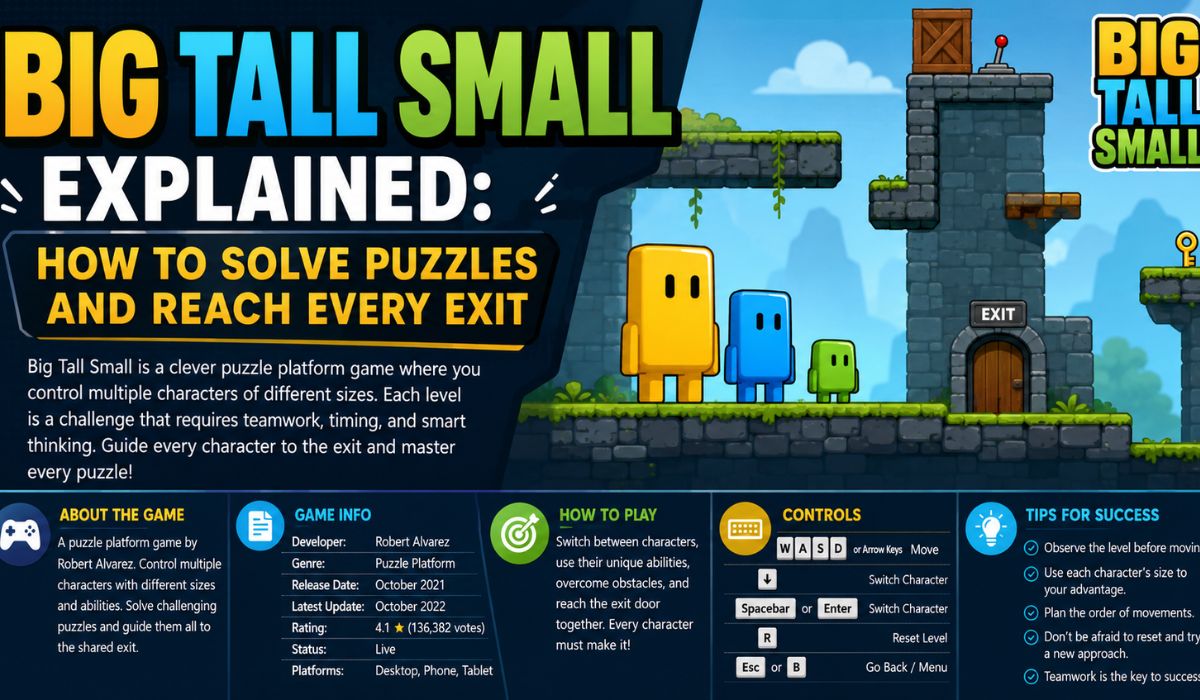
Puzzle games often look simple at first, but the best ones reveal surprising depth once you begin playing. Big Tall Small is one of those games. At a glance, it appears to be a colorful platform adventure built around movement and timing. After only a few levels, however, it becomes clear that the real challenge is not speed but problem solving.
Big Tall Small takes a creative idea and builds an entire experience around it. Instead of controlling a single character, players must guide multiple characters that differ in size and behavior. Every level asks you to think about space, movement, order, and timing. Reaching the exit is not enough unless every character arrives successfully.
This design creates a puzzle platform experience that feels approachable for beginners while remaining rewarding for players who enjoy solving increasingly complex challenges. Released in 2021 and updated in 2022, Big Tall Small continues to attract players because of its simple controls, clever level design, and satisfying sense of progress.
This guide explores everything you need to know about Big Tall Small in 2026. You will learn how the game works, how to approach puzzles, how to switch characters efficiently, and how to improve your chances of reaching every exit without frustration.
Quick Bio Information
| Detail | Information |
|---|---|
| Game Title | Big Tall Small |
| Genre | Puzzle Platform Game |
| Main Style | Multi-Character Puzzle Solving |
| Developer | Robert Alvarez |
| Original Release | October 2021 |
| Latest Update | October 2022 |
| Current Status | Live |
| Average Rating | 4.1 / 5 |
| Player Votes | 136,000+ |
| Primary Goal | Reach The Shared Exit |
| Gameplay Focus | Logic And Coordination |
| Character System | Multiple Playable Characters |
| Supported Devices | Desktop, Phone, Tablet |
| Difficulty Style | Gradually Increasing |
| Main Skills Needed | Observation And Planning |
| Controls | Keyboard And Touch Support |
| Reset Function | Available During Levels |
| Session Length | Short To Medium |
| Suitable For | Casual And Puzzle Players |
| Best Feature | Creative Character Switching |
What Is Big Tall Small?
Big Tall Small is a puzzle platform game built around one central idea: different characters solve different parts of the same problem.
Instead of moving one hero from start to finish, players control a group that must work together to complete a level. Every environment contains obstacles, platforms, narrow passages, and movement challenges that require thoughtful positioning.
The game combines traditional platform elements with logic-based progression. Jumping and movement matter, but success depends more on understanding how each character fits into the level design.
One reason Big Tall Small remains interesting is that it teaches through experience rather than long instructions. Early stages introduce simple concepts. Later levels gradually combine multiple mechanics until players begin thinking several moves ahead.
Because levels remain compact and focused, the game encourages experimentation. Players can retry quickly, learn from mistakes, and develop better solutions.
This approach makes Big Tall Small accessible to new players while giving puzzle fans enough challenge to stay engaged.
How Big Tall Small Works: Understanding The Core Gameplay
At its heart, Big Tall Small follows a clear gameplay loop.
You begin a level with multiple characters placed in a designed environment. Somewhere in that level is the exit. Your objective is to move everyone safely to that destination.
The challenge comes from how differently the characters interact with the world.
Some routes appear impossible at first glance. One path may be too high, another too narrow, and another may require one character to move first before the others can continue.
This creates a chain reaction of decisions.
A typical level often begins with observation. Before moving, successful players scan the environment and identify possible routes. Then they decide which character should move first.
As levels become more advanced, players discover that solving puzzles becomes less about reacting and more about planning.
Another reason the gameplay works well is that failure never feels overly punishing. Restarting is quick, allowing players to immediately test new ideas.
That fast learning cycle keeps Big Tall Small enjoyable even when challenges become difficult.
Meet The Characters: What Big, Tall, And Small Each Do
The title itself tells players something important.
Every character brings unique movement possibilities, and understanding those differences is the key to solving puzzles efficiently.
The larger character usually creates opportunities where space and positioning matter. Bigger movement areas may allow access to routes that smaller characters cannot use.
The tall character introduces another layer of strategy. Vertical movement, reaching elevated areas, and creating opportunities become important parts of solving levels.
The smaller character changes how players think about space. Areas that seem inaccessible may suddenly become possible through tighter routes and alternative paths.
The real challenge is not learning each character individually.
The challenge is learning how they work together.
Many levels are designed so one character prepares the environment while another finishes the puzzle. This encourages players to stop thinking in terms of individual solutions and start treating the entire team as one connected system.
As players improve, switching between characters becomes smoother and more intentional.
Eventually, many puzzles can be solved almost like choreography.
Controls Guide: How To Move, Switch, And Reset Efficiently
Big Tall Small uses simple controls, which helps players focus on solving puzzles instead of memorizing complicated inputs.
Movement is controlled using either W, A, S, D or the arrow keys.
Character switching happens through the Down Arrow, Spacebar, or Enter depending on player preference.
Resetting can be done instantly using the R key.
Returning or exiting uses Esc or B.
Although these controls seem basic, using them efficiently makes a noticeable difference.
Experienced players avoid unnecessary movement and switch characters frequently instead of trying to complete large portions of a level with one character at a time.
Another useful habit is resetting early.
Many players waste time trying to recover mistakes. Since restarting is immediate, experienced players often reset and attempt cleaner solutions.
Mobile and tablet support also makes the game approachable for touch players. While movement feels slightly different compared to desktop controls, the puzzle design remains enjoyable across devices.
Mastering controls does not mean becoming faster.
It means becoming smoother.
How To Solve Puzzles Faster In Big Tall Small
Most players who struggle with Big Tall Small are not moving too slowly.
They are solving problems in the wrong order.
The first habit to build is observation.
Before moving any character, study the level layout. Look at the exit position, available platforms, narrow spaces, and possible movement paths.
Next, identify limitations.
Ask simple questions.
Who can reach the high platform?
Who fits through the small opening?
Which movement creates progress for everyone else?
Thinking this way turns difficult puzzles into manageable steps.
Another useful strategy is dividing the level into stages.
Instead of trying to complete everything at once, focus on creating one successful position at a time.
Many players also improve by paying attention to failed attempts.
If a route almost worked, adjust only one variable instead of changing the entire solution.
Finally, avoid rushing.
Big Tall Small rewards planning more than fast reactions.
The players who finish consistently are usually the players who pause, think, and move with purpose.
That simple change often turns impossible-looking puzzles into surprisingly clear solutions.
Best Beginner Tips To Reach Every Exit
Starting Big Tall Small can feel easier than it really is. The first few levels teach movement and switching, but later stages begin combining ideas in ways that force players to think more carefully. New players often assume faster movement leads to success. In reality, thoughtful decisions matter far more.
One of the most helpful habits is slowing down at the beginning of each level. Spend a few seconds understanding what the environment is asking you to do. Notice platform heights, open spaces, blocked routes, and areas that look intentionally designed for one particular character.
Another useful approach is treating failed attempts as information rather than mistakes. Puzzle games reward discovery. If one route fails, you usually learn something valuable about the level.
Character switching should also happen more often than beginners expect. Some players try to move one character as far as possible before changing. Big Tall Small becomes easier when movement feels shared between all characters.
Good players also develop a habit of maintaining flexible positions. Avoid placing characters into awkward spots that make recovery difficult later.
Patience becomes surprisingly powerful.
Levels that seem impossible often become clear after stepping back and looking at the full puzzle rather than individual obstacles.
As your understanding grows, solving levels starts feeling less like guessing and more like reading patterns.
Common Obstacles And How To Beat Them
Big Tall Small gradually introduces situations that force players to combine movement with planning. While levels change, certain challenge types appear repeatedly.
Height differences are among the earliest obstacles. One character may reach an elevated platform while another cannot. These moments encourage players to think about sequencing instead of direct movement.
Narrow passages create another common challenge. Not every character fits everywhere. Players quickly learn that reaching the exit sometimes means sending different characters through completely different routes.
Timing sections also appear in later progression. These moments require smooth switching and efficient positioning rather than quick reflexes.
Blocked paths often teach an important lesson: not every route is meant to be solved immediately.
Sometimes progress only becomes possible after moving another character first.
Another obstacle comes from overcomplication.
Players occasionally create unnecessary movement because they assume the solution must be difficult.
Big Tall Small often rewards elegant thinking.
If a puzzle feels overly complicated, there may be a simpler answer.
One useful mindset is asking what the level wants to teach.
Most challenges introduce ideas intentionally and rarely require random experimentation.
Over time, recognizing these patterns makes difficult levels feel much more manageable.
Advanced Strategies For Completing Harder Levels
Once players understand the basics, Big Tall Small reveals another level of depth.
Advanced play is not about discovering secret mechanics.
It is about improving efficiency and reducing unnecessary decisions.
One effective technique is planning backward.
Instead of asking how to begin, start by imagining what the final positions must look like before reaching the exit.
This approach often reveals which character should move first.
Advanced players also reduce movement waste.
Every unnecessary jump or reposition increases complexity and creates more opportunities for mistakes.
Experienced players begin creating movement chains.
One character moves to create access.
Another uses that position to continue.
Then the final character completes the route.
This creates smoother progression and fewer resets.
Another advanced skill is developing level memory.
Repeated puzzle structures begin appearing throughout the game.
Recognizing familiar ideas allows players to predict solutions more quickly.
Strong players also become comfortable abandoning failed plans early.
Restarting quickly often saves more time than trying to rescue a broken attempt.
At higher levels, success comes from confidence, observation, and clean execution.
Why Big Tall Small Is More Than A Simple Puzzle Game
At first glance, Big Tall Small appears to be another browser puzzle platform game.
After spending time with it, the design reveals more thoughtful ideas underneath.
Many puzzle games depend on difficult controls or hidden solutions.
Big Tall Small takes a different approach.
Its challenge comes from understanding systems.
Players succeed because they learn.
This creates a rewarding feeling of progress.
Instead of collecting upgrades or unlocking stronger abilities, players improve through experience.
Another reason the game feels memorable is its accessibility.
Controls remain simple.
Levels stay focused.
The visual presentation keeps attention on solving rather than distraction.
There is also a satisfying balance between experimentation and structure.
Levels encourage creativity while still leading players toward logical solutions.
This design makes completion feel earned.
Big Tall Small also works well in shorter sessions.
Players can complete a few levels, leave, and return without losing progress in understanding.
That flexibility continues to make puzzle platform games appealing in 2026.
For many players, the strongest feature is not the challenge.
It is the moment when a puzzle suddenly makes sense.
That small moment of discovery is where the game shines.
Is Big Tall Small Worth Playing Today?
Even years after release, Big Tall Small remains easy to recommend for players who enjoy thoughtful gameplay.
The game succeeds because it focuses on one idea and executes it well.
Instead of adding endless mechanics, it develops character coordination and puzzle solving in meaningful ways.
Players looking for action-heavy experiences may find the pace slower.
Players who enjoy thinking, experimenting, and solving movement challenges are more likely to appreciate what the game offers.
Its support across desktop, phone, and tablet also makes it accessible to different play styles.
Another advantage is the straightforward learning curve.
The game does not require previous puzzle experience.
New players can enter comfortably while still finding enough depth to stay engaged.
From a modern perspective in 2026, Big Tall Small still feels relevant because strong puzzle design ages well.
Creative mechanics and clear goals remain enjoyable long after release.
For players who enjoy platform challenges, logical progression, and satisfying problem solving, Big Tall Small continues to be a worthwhile experience.
And for players willing to slow down and think carefully, reaching every exit becomes one of the most rewarding parts of the journey.
Final Thoughts: Master Every Puzzle And Reach Every Exit
Big Tall Small proves that a great puzzle game does not need complicated systems or endless features to feel rewarding.
Its strength comes from simplicity used in smart ways.
By giving players multiple characters with different strengths and asking them to work together, the game transforms ordinary platform movement into something more thoughtful and engaging.
What begins as a straightforward puzzle experience gradually becomes a game about planning, experimentation, and discovering better solutions.
The levels encourage observation.
The controls stay accessible.
The challenge feels fair.
Most importantly, progress feels earned.
For players who enjoy solving problems instead of simply reacting, Big Tall Small remains a memorable experience in 2026.
If you are approaching the game for the first time, focus on understanding the level before moving.
Switch characters often.
Do not fear restarting.
Look for patterns.
And remember that every puzzle usually becomes easier once you stop trying to force the solution.
Eventually, you begin seeing the game differently.
Platforms become opportunities.
Obstacles become clues.
And reaching every exit becomes more than completing a level—it becomes proof that careful thinking and creative problem solving can turn even the most confusing challenge into a clear path forward.
That is what makes Big Tall Small worth playing and worth mastering.
Frequently Asked Questions About Big Tall Small
Is Big Tall Small Free To Play?
Big Tall Small is generally available as a browser-based experience and can typically be played without purchasing the game. Availability may vary depending on the platform hosting it, but the core appeal comes from being easy to access and simple to start. Players can jump in quickly without a long setup process, making it attractive for casual gaming sessions.
Can You Play Big Tall Small On Mobile Devices?
Yes. Big Tall Small supports mobile devices along with desktop and tablet play. The controls feel slightly different depending on screen size and input method, but the puzzle design remains consistent. Mobile support makes it easier to enjoy short play sessions while still experiencing the complete puzzle-solving challenge.
How Many Characters Do You Control In Big Tall Small?
The game revolves around controlling multiple characters that differ in size and movement possibilities. Instead of focusing on a single character, players switch between them throughout each level. The entire puzzle system depends on understanding how each character contributes to reaching the shared exit.
Is Big Tall Small Difficult For Beginners?
Big Tall Small starts with approachable levels and gradually becomes more demanding. Early stages help players understand movement and switching mechanics before introducing more complex puzzle combinations. Difficulty increases through smarter design rather than faster reactions, which makes the experience feel fair and rewarding.
What Type Of Game Is Big Tall Small?
Big Tall Small belongs primarily to the puzzle platform genre. It combines movement, environmental problem solving, and multi-character coordination. Unlike traditional platform games that focus mainly on timing, this game places stronger emphasis on planning and observation.
How Long Does It Take To Improve At Big Tall Small?
Improvement usually happens naturally through repetition and pattern recognition. Players often notice progress after learning to pause before moving and understanding how character abilities connect. The more puzzles you solve, the easier it becomes to recognize possible solutions quickly.
Does Big Tall Small Require Fast Reflexes?
Not usually. While timing occasionally matters, most challenges reward logical thinking and preparation. Players who observe carefully and move deliberately often perform better than players who rush.
Why Do Players Keep Returning To Big Tall Small?
The biggest reason is satisfaction.
Big Tall Small creates moments where difficult puzzles suddenly become clear. That feeling of understanding a level and completing it through planning keeps players engaged and encourages them to continue improving.
Recommended For You: Shark.io Explained: How to Dominate the Ocean in This Multiplayer Battle Arena