
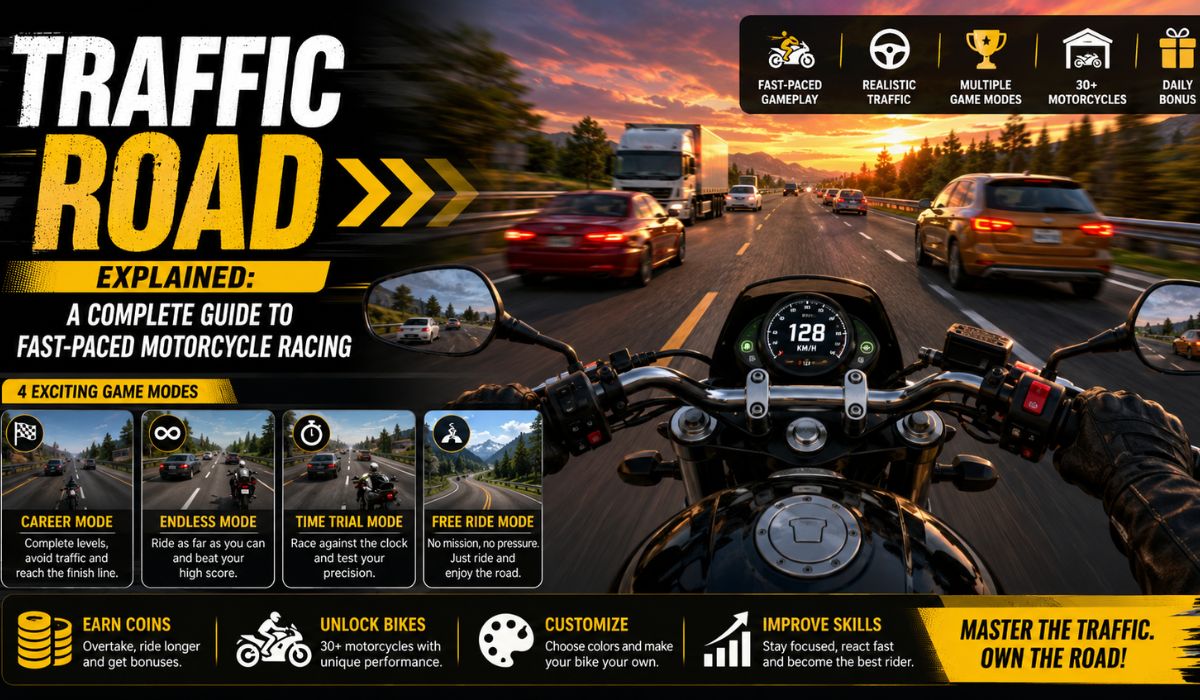
Speed games have always attracted players who enjoy quick reactions, focus, and the excitement of pushing limits. Among modern browser and mobile driving experiences, Traffic Road has become a popular choice because it combines fast motorcycle riding with realistic traffic movement and simple controls.
Unlike traditional racing games that place players on closed circuits, Traffic Road creates a different kind of challenge. The road stays open, vehicles move unpredictably, and every decision matters. One wrong movement can end a great run instantly. That simple idea makes the game easy to understand but surprisingly difficult to master.
Traffic Road places players behind the handlebars in a first-person view and asks them to survive, score points, unlock motorcycles, and improve their riding skills. Whether someone wants relaxed riding or intense high-speed challenges, the game offers several ways to play.
This guide explains everything about Traffic Road in a clear and practical way. You will learn how the game works, how to start correctly, which modes to try first, and how to build the skills needed to become a better rider.
Quick Bio Information
| Information | Details |
|---|---|
| Game Name | Traffic Road |
| Genre | Motorcycle Racing Game |
| Gameplay Style | Endless Driving And Traffic Navigation |
| Camera View | First-Person Perspective |
| Main Goal | Avoid Traffic And Travel Further |
| Difficulty | Easy To Learn, Hard To Master |
| Platform Support | Browser And Mobile |
| Starting Vehicle | Default Motorcycle |
| Progression System | Coins And Unlocks |
| Number Of Motorcycles | 30 |
| Unlock Method | Earn Coins Through Gameplay |
| Fast Progress Method | Distance And Near Misses |
| Main Skill Required | Reflex And Timing |
| Available Modes | Career, Endless, Time Trial, Free Ride |
| Customization | Motorcycle Colors And Selection |
| Mobile Steering | Device Tilt |
| Desktop Controls | Arrow Keys |
| Reward System | Scores, Coins, Bonuses |
H2: What Is Traffic Road?
Traffic Road is a motorcycle racing and driving game built around speed, precision, and survival. Instead of racing against opponents on a closed track, players ride through active highways filled with moving vehicles.
The challenge comes from maintaining momentum while avoiding collisions. The faster the ride becomes, the less time players have to react. Success depends on balancing speed with control.
One feature that makes Traffic Road stand out is its first-person motorcycle view. This perspective creates a stronger sense of movement and makes every lane change feel more intense. Roads appear closer, traffic seems faster, and players must stay alert at all times.
Traffic Road is not only about reaching top speed. The game rewards smart movement, efficient overtaking, and careful observation. Learning when to accelerate and when to slow down becomes more important than simply holding maximum speed.
As players progress, they unlock motorcycles with different performance characteristics. Some offer better acceleration while others provide stronger handling or braking performance.
That progression creates long-term motivation and gives players reasons to return and improve.
H2: How Traffic Road Gameplay Works
At its core, Traffic Road follows a simple gameplay loop that becomes more exciting over time.
Players begin by selecting a motorcycle and choosing a mode. Once the ride starts, traffic begins moving immediately. Cars appear across lanes, and players must navigate safely while maintaining speed.
Distance is an important factor in scoring. Longer rides generally produce higher rewards. However, the game encourages risk-taking through bonus opportunities.
One of the most rewarding mechanics is the near-miss system. Riding close to traffic vehicles without crashing can increase scores and generate additional rewards. This creates a constant decision between safety and aggression.
Another important gameplay element is traffic reading. Vehicles do not always move at identical speeds, which means players need to anticipate gaps before changing lanes.
Because of this design, Traffic Road feels more strategic than many simple racing games.
Progress usually follows this pattern:
Ride → Earn Rewards → Unlock Motorcycles → Improve Performance → Attempt Harder Challenges
This progression system helps keep the experience fresh even after multiple sessions.
H2: Getting Started In Traffic Road For Beginners
New players often try to ride as fast as possible immediately. In Traffic Road, that approach usually ends quickly.
The better strategy is to treat the first sessions as practice.
When starting the game, players receive the default motorcycle. Early performance values are balanced enough to help new riders understand acceleration, steering, and braking.
Before chasing high scores, spend time becoming comfortable with lane changes.
During the first rides, focus on:
Learning vehicle spacing.
Understanding reaction timing.
Recognizing traffic flow.
Testing braking distances.
Many beginners make the mistake of steering sharply at high speed. Small and controlled movements produce better results.
Free Ride Mode is often a useful place to build confidence because there is less pressure compared with mission-based progression.
Once basic movement feels natural, players can begin experimenting with faster riding and more aggressive overtaking.
Patience early on usually leads to stronger long-term results.
H2: Traffic Road Controls Explained
Traffic Road uses a straightforward control system that allows players to focus more on movement than complicated inputs.
On desktop devices:
Up Arrow increases acceleration.
Down Arrow activates braking.
Left And Right Arrows control steering.
Although the controls appear simple, mastering timing requires practice.
Acceleration should not remain active continuously. Controlled bursts often create smoother navigation.
Braking also becomes more important as speed increases. Players who ignore braking frequently create situations that cannot be recovered.
On mobile devices, controls become more immersive.
Players steer by tilting their device while pressing and holding the screen to accelerate.
Mobile gameplay can initially feel more sensitive, but many players enjoy the stronger sense of control.
Good control habits include:
Looking ahead rather than focusing directly in front of the motorcycle.
Avoiding sudden lane changes.
Maintaining stable movement.
Using speed strategically.
Developing these habits early improves overall performance.
H2: All Traffic Road Game Modes Explained
Traffic Road includes multiple modes that create different experiences for different types of players.
Career Mode
Career Mode gives players structured progression through individual stages.
Each level introduces objectives that typically involve reaching a destination within a time limit while avoiding collisions.
The further players progress, the more demanding the traffic becomes.
Career Mode works especially well for players who enjoy clear goals and gradual difficulty increases.
This mode also encourages learning because mistakes become easier to identify.
Endless Mode
Endless Mode removes finish lines and focuses entirely on distance.
Players continue riding until they crash.
Some variations introduce two-way traffic, making decision-making much harder.
This mode becomes one of the best places to test personal records and develop consistency.
Long runs require concentration and efficient speed control.
Time Trial Mode
Time Trial Mode increases pressure by introducing strict time limits.
Players must ride efficiently and avoid hesitation.
Unlike Endless Mode, unnecessary braking can reduce success.
This mode rewards precision and route planning.
Players often improve reaction speed after spending time in Time Trial challenges.
Free Ride Mode
Free Ride Mode offers the most relaxed experience.
There are no major objectives or pressure to perform.
Players can simply explore roads, practice movement, and experiment with motorcycles.
Many experienced players still return to this mode to warm up before more demanding sessions.
Free Ride also allows players to become comfortable with different motorcycle handling styles.
As a learning environment, it may be the most underrated mode in Traffic Road.
H2: How Scoring And Coins Work In Traffic Road
Once players understand movement and traffic patterns, the next goal becomes improving scores and earning coins. Traffic Road uses a progression system that rewards both distance and skill.
Driving farther generally increases rewards, but distance alone is not enough for top performance. The game encourages players to take calculated risks.
One of the biggest score boosters comes from close overtakes. Passing near traffic vehicles without colliding often generates bonus rewards. These moments create excitement because players must judge speed and spacing accurately.
Speed itself can also influence rewards. Maintaining higher speeds creates opportunities to collect more points over time, although faster riding naturally increases difficulty.
Coins play an important role because they unlock additional motorcycles and access to more content. Players who focus on smooth runs rather than reckless speed often collect rewards faster over the long term.
A useful mindset is to think of Traffic Road as a balance game instead of a pure racing game. Controlled aggression usually wins.
H2: Motorcycles, Garage Features, And Upgrades
The motorcycle system is one of the features that gives Traffic Road long-term replay value.
Players begin with a default motorcycle and gradually unlock additional models using earned coins. The collection eventually expands to dozens of motorcycles with different performance profiles.
Every bike feels slightly different.
Some motorcycles emphasize raw speed and acceleration.
Others provide better handling and smoother turning.
Some focus on stronger braking performance.
Understanding these attributes changes how players approach different modes.
Acceleration becomes valuable when players need quick recovery after slowing down.
Handling helps during heavy traffic situations.
Braking becomes increasingly useful at high speeds.
The Garage allows players to browse motorcycles, compare performance, and personalize appearance through color changes where available.
New players sometimes rush to unlock expensive motorcycles immediately. A smarter approach is to unlock gradually and spend time mastering each bike before moving to another.
Skill usually improves performance more than upgrades alone.
H2: Best Tips And Strategies To Improve Faster
Traffic Road rewards players who develop habits instead of relying on reactions alone.
One of the strongest strategies is learning to look farther ahead. Many crashes happen because players focus only on the closest vehicle instead of reading upcoming traffic.
Another important technique is lane positioning.
Staying slightly off-center often creates more escape options.
Speed control also matters more than most players expect. Driving at maximum speed all the time reduces available reaction time.
Short controlled accelerations frequently lead to longer runs.
Consistency becomes especially important during dense traffic.
Experienced players often develop rhythm rather than making constant sudden adjustments.
Recovery skills are equally valuable.
When entering difficult sections, reducing speed briefly can preserve an entire run.
Over time, players begin recognizing traffic patterns and reacting automatically.
That is usually the point where scores improve rapidly.
H2: Common Traffic Road Mistakes Players Should Avoid
Most crashes in Traffic Road happen because of predictable habits.
One common mistake is treating every road section the same. Traffic density changes constantly, which means speed should change too.
Another mistake is chasing every near miss.
Bonus rewards look attractive, but forcing risky passes often ends successful runs.
Many beginners also underestimate braking.
Braking is not a sign of slow play. It creates opportunities to reposition and maintain control.
Oversteering causes another frequent problem.
Sharp movements at high speed reduce stability and make recovery difficult.
Players also sometimes switch motorcycles too frequently.
Constant changes can interrupt learning because every bike feels slightly different.
Perhaps the biggest mistake is becoming impatient.
Long-term improvement usually comes from smoother riding rather than faster riding.
Players who stay calm often achieve better results.
H2: What Makes Traffic Road So Addictive?
Traffic Road succeeds because it creates short moments of tension and reward repeatedly.
Each run feels slightly different.
Traffic changes.
Decisions change.
Mistakes happen unexpectedly.
That unpredictability creates replay value.
The game also delivers clear feedback.
Players instantly know whether a decision worked or failed.
This encourages quick learning and repeated attempts.
Another reason players return is progression.
Unlocking motorcycles creates visible goals beyond simple score chasing.
Short game sessions also make Traffic Road easy to revisit.
A player can enjoy a quick ride or spend longer periods trying to improve records.
The first-person perspective strengthens immersion and makes small victories feel more exciting.
Many players continue because they believe the next run could always be better.
That feeling keeps gameplay fresh.
H2: Traffic Road Features That Stand Out
Traffic Road includes several features that help it stand apart from simple endless driving games.
The first-person motorcycle camera creates stronger immersion and increases the sense of speed.
Multiple game modes allow players to choose between structured progression and relaxed practice.
Motorcycle variety encourages experimentation and keeps progression interesting.
Traffic behavior creates changing challenges rather than predictable routes.
Road environments and unlockable content help maintain long-term interest.
The reward system also supports replayability because players continually work toward new motorcycles and improved performance.
Another strength is accessibility.
The controls remain easy to understand while still allowing room for skill growth.
That combination helps Traffic Road appeal to both casual players and more competitive players.
H2: Traffic Road Vs Other Motorcycle Racing Games
Traffic Road approaches motorcycle racing differently from many traditional racing games.
Classic racers often focus on lap times, opponent positions, and track memorization.
Traffic Road shifts attention toward survival, adaptation, and decision-making.
Instead of memorizing a course, players react continuously.
Compared with arcade racers, Traffic Road usually feels simpler to enter but more demanding to master.
Compared with simulation games, it focuses less on technical mechanics and more on flow and reflexes.
Players who enjoy quick sessions and visible improvement often find Traffic Road especially satisfying.
Those looking for competitive racing championships may prefer traditional racers.
Neither approach is better.
They simply create different experiences.
Traffic Road succeeds because it turns everyday traffic navigation into a surprisingly exciting challenge
H2: Building Long-Term Skill In Traffic Road
Improvement in Traffic Road rarely happens overnight.
Strong players usually build habits gradually.
The first stage is survival.
The second stage is efficiency.
The third stage is controlled risk.
As confidence grows, players begin making smoother decisions and recognizing traffic patterns earlier.
Practicing across different modes accelerates learning because each mode emphasizes different strengths.
Career Mode builds consistency.
Endless Mode improves concentration.
Time Trial develops fast decision-making.
Free Ride strengthens comfort and experimentation.
Players who rotate between modes often become more complete riders.
Traffic Road rewards patience, observation, and small improvements over time.
That makes progress feel earned and satisfying.
H2: Why Traffic Road Keeps Players Coming Back
Many racing games deliver excitement for a short time and then begin to feel repetitive. Traffic Road works differently because each session creates new situations.
Even if players choose the same mode repeatedly, traffic movement changes the experience. One run may feel smooth and controlled, while the next may become unpredictable within seconds.
This changing environment gives players a reason to improve instead of simply repeating identical actions.
Another factor is measurable progress.
Players unlock motorcycles.
They improve personal records.
They discover better routes through traffic.
Small improvements become visible quickly, which creates a satisfying learning cycle.
Traffic Road also supports different play styles.
Some players enjoy high-risk overtaking.
Others prefer safe and consistent riding.
Because multiple approaches can work, the experience feels flexible instead of restrictive.
This balance between challenge and accessibility helps maintain long-term interest.
H2: How To Get More Enjoyment From Traffic Road
Traffic Road becomes more enjoyable when players focus on improvement rather than only chasing records.
One effective approach is setting personal goals.
Instead of aiming only for coins, try improving consistency, surviving longer, or mastering a new motorcycle.
Experimenting with modes also keeps gameplay fresh.
Career Mode introduces structure.
Endless Mode tests patience.
Time Trial rewards efficiency.
Free Ride allows relaxed practice.
Changing objectives prevents fatigue and develops broader skills.
Players may also discover that shorter sessions often produce better performance than very long sessions.
Because concentration matters, returning with fresh focus can improve results.
The most enjoyable experience usually comes from balancing challenge with control.
Traffic Road feels best when speed and decision-making work together.
H2: The Future Appeal Of Traffic Road In 2026
Fast-paced driving games continue evolving, but Traffic Road remains appealing because its design is straightforward and accessible.
Modern players often look for games that are quick to start yet rewarding to master.
Traffic Road fits that style well.
The game’s first-person motorcycle perspective continues to feel engaging, especially for players who enjoy immersive movement without complicated systems.
Progression through motorcycles, score improvement, and mode variety helps keep the experience relevant.
Another reason for continued interest is convenience.
Players can enjoy short sessions without needing long tutorials or major time commitments.
As driving games continue growing across browser and mobile platforms, Traffic Road remains an example of how simple mechanics can still create exciting gameplay.
Its long-term appeal comes from execution rather than complexity.
H2: Final Thoughts
Traffic Road proves that a motorcycle racing game does not need complicated systems to stay exciting.
By combining speed, traffic awareness, progression, and first-person immersion, the game creates a fast and rewarding experience that remains easy to understand.
Players begin with simple controls but quickly discover deeper layers of timing, decision-making, and strategy.
The different game modes allow both relaxed riding and high-pressure challenges.
The motorcycle collection system gives players goals beyond score chasing.
Most importantly, Traffic Road rewards improvement.
Every ride teaches something new.
Every mistake builds experience.
Every successful run feels earned.
Whether you are completely new to motorcycle games or simply looking for a fast and enjoyable racing experience, Traffic Road offers enough challenge and replay value to stay entertaining for a long time.
Ride smart, stay focused, and enjoy the road ahead.
FAQs About Traffic Road
Is Traffic Road Easy For Beginners?
Traffic Road is easy to start because the controls are simple and the objectives are clear. However, becoming consistently successful takes practice. New players usually improve fastest by focusing on control and observation instead of speed.
What Is The Best Game Mode To Start With?
Free Ride Mode is often the most comfortable place for beginners because there is less pressure. After learning movement and traffic flow, Career Mode becomes a good next step for structured progression.
How Do You Earn More Coins In Traffic Road?
Coins are generally earned by riding longer distances, maintaining good performance, and collecting bonuses through skilled driving. Consistent runs often produce better rewards than aggressive short runs.
Does Choosing A Better Motorcycle Guarantee Higher Scores?
Not necessarily. Faster motorcycles can create advantages, but player skill remains more important. Understanding timing, braking, and traffic reading usually improves results more than upgrades alone.
Why Do Players Crash Frequently At High Speed?
Higher speed reduces reaction time. Many crashes happen because players focus too closely on nearby vehicles instead of reading the road ahead. Controlled acceleration often leads to longer rides.
Can Traffic Road Be Played Casually?
Yes. Traffic Road works well for short and casual sessions. Free Ride Mode especially allows players to enjoy riding without pressure while improving naturally over time.
What Makes Traffic Road Different From Traditional Racing Games?
Traditional racing games often focus on opponents and track positions. Traffic Road focuses more on traffic navigation, survival, reaction speed, and maintaining momentum through changing road conditions.
Is Traffic Road Worth Playing In 2026?
For players who enjoy motorcycle games, quick sessions, and skill-based progression, Traffic Road continues to offer an entertaining experience. Its combination of simple controls and rewarding gameplay keeps it relevant and enjoyable.
Recommended For You: Swingo Explained: A Fun Guide To The Fast-Paced Bouncy Puzzle Game